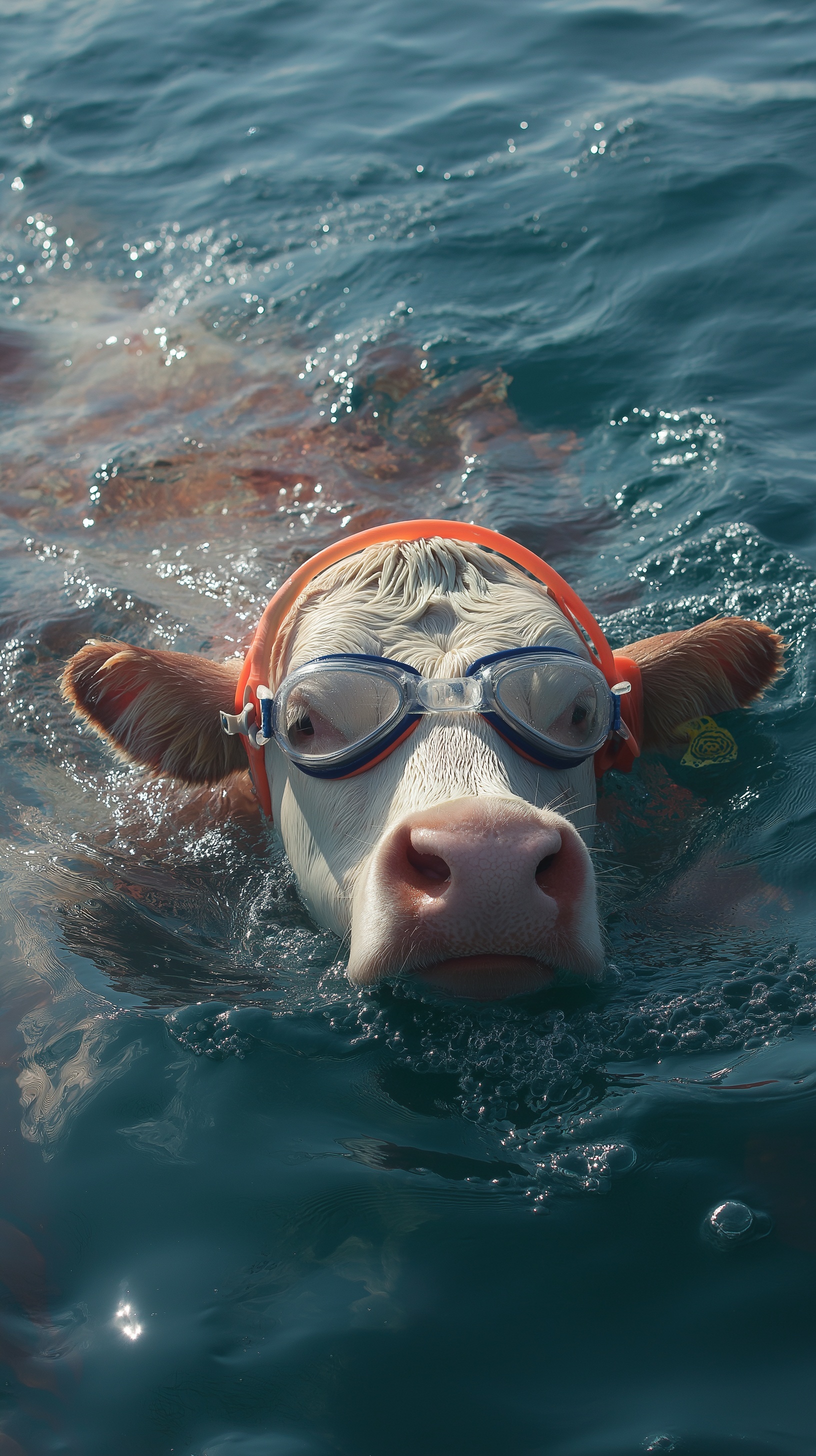
Photorealistic close-up of a white and caramel-spotted cow swimming in crystalline turquoise ocean water, wearing vintage swimming goggles with clear glass lenses, blue rubber seals, and bright orange silicone strap, head breaking surface with water streaming down face, direct eye contact with subtle relaxed expression, midday Mediterranean sunlight at 45-degree angle creating explosive specular highlights and caustic light patterns on rippling surface, shallow depth of field with creamy bokeh bubbles, warm fur tones against cool cyan-teal water palette, Super 35mm sensor aesthetic, photojournalistic composition, ultra-detailed wet fur texture with individual strands catching light, water droplets with rainbow refractions, subtle anamorphic lens flare, film grain texture, natural chromatic aberration on highlight edges --ar 2:3 --style raw --s 250
Quick Tip: Click the prompt box above to select it, then press Ctrl+C (Cmd+C on Mac) to copy. Paste directly into Midjourney, DALL-E, or Stable Diffusion and customize to make it your own!
The image generation model processes the initial token group as a high-level scene classifier, not as a descriptive sentence. When the prompt begins with "Photorealistic close-up," the model immediately routes the latent space toward texture-heavy, shallow depth-of-field photography styles. This first-pass routing determines the base noise distribution. If the opening tokens are generic, the model defaults to a stock-photo aesthetic that flattens the surreal elements. The mechanism works because the transformer architecture weights early tokens more heavily in the cross-attention layers, effectively locking the visual genre before the subject is even parsed. This is why the specific phrase "photorealistic close-up" must precede the cow description.
Once the classifier locks the genre, the subject tokens activate specific embedding clusters. The phrase "white and caramel-spotted cow" triggers a complex intersection of animal anatomy and color distribution. The model must reconcile the biological structure of a bovine head with the unnatural context of swimming. If the prompt places the subject before the camera settings, the model may prioritize the animal's shape over the photographic rendering. The correct sequence forces the model to treat the cow as a physical object within a specific lens environment, rather than a flat illustration. This distinction is critical for achieving the wet fur texture and water interaction visible in the reference image.
Why the Original Prompt Produces Plastic Skin and Flat Water
The primary failure mode in surreal animal generation is the "plastic skin" effect, caused by conflicting texture tokens. In the original prompt, the model receives instructions for both "ultra-detailed wet fur texture" and "crystalline turquoise ocean water." Without a clear separation of materials, the diffusion process blends the fur and water into a uniform, glossy surface. The model interprets the high-frequency detail of the fur and the high-frequency specular of the water as the same material property. This results in a cow that looks like a rubber toy dipped in oil, rather than a biological creature interacting with a liquid environment.
Another root cause is the misuse of lighting descriptors. The phrase "explosive specular highlights" is a strong token that pushes the model toward high-contrast rendering. However, when combined with "midday Mediterranean sunlight," the model overcorrects and blows out the highlights on the goggles and nose. This destroys the subtle skin texture and the rainbow refractions in the water droplets. The model needs a specific light angle to create caustics without flattening the subject. A 45-degree angle is ideal for water interaction, but it requires the prompt to specify the surface normal—the direction the water is facing—to calculate the refraction correctly.
The final structural problem is the lack of a defined focal plane. The prompt asks for "shallow depth of field with creamy bokeh bubbles," but it does not specify where the focus point should lie. The model then distributes focus evenly across the entire image, making the background water as sharp as the cow's eyes. This flattens the depth and removes the cinematic quality. A photojournalistic composition requires a clear separation between the subject and the environment. The fix is to explicitly state the focus target, such as "sharp focus on the cow's eyes and goggles, with the background water falling into soft bokeh."
The Root Cause: Token Weighting and Material Confusion
The underlying mechanism causing these issues is the way the model's cross-attention layers handle conflicting material descriptors. When the prompt includes "fur" and "water" in the same clause, the model's attention mechanism may assign similar weights to both, leading to a hybrid texture. This is not a failure of the model's capability, but a failure of prompt structure. The model does not understand that fur and water are different physical states; it only understands statistical co-occurrence. To fix this, the prompt must use distinct spatial and material clauses that separate the subject from the environment.
Furthermore, the model's interpretation of "photorealistic" is heavily influenced by the camera sensor specified. The original prompt uses "Super 35mm sensor aesthetic," which is a strong token for film-like rendering. However, without a corresponding lens specification, the model defaults to a generic 50mm focal length. This creates a perspective that is too wide for a close-up, distorting the cow's proportions. The fix is to pair the sensor with a specific lens, such as "85mm portrait lens," which compresses the background and isolates the subject. This combination forces the model to render the cow with the correct facial proportions and the water with the appropriate depth compression.
The final root cause is the absence of a temporal or physical state descriptor. The prompt describes the cow "swimming," but it does not specify the phase of the stroke. The model then renders a static, floating head. To create the illusion of motion, the prompt must include a dynamic verb like "head breaking the surface" or "water streaming down the face." These tokens activate the model's motion-blur and fluid-simulation priors, adding the necessary kinetic energy to the image. Without them, the cow looks like it is suspended in gelatin, not swimming in an ocean.
The Fix: Restructuring the Prompt for Material Separation
To fix the material confusion, the prompt must be reorganized into distinct clauses. Start with the camera and lens, then the subject, then the lighting, and finally the environmental interaction. For example, begin with "Super 35mm sensor, 85mm lens, photorealistic close-up." This locks the photographic style. Then, describe the subject: "white and caramel-spotted cow, wet fur texture, vintage swimming goggles." The model now treats the cow as a distinct object. Finally, describe the environment: "crystalline turquoise ocean water, caustic light patterns, shallow depth of field." This separation prevents the model from blending the fur and water into a single material.
Next, address the lighting by specifying the angle and the surface interaction. Instead of "explosive specular highlights," use "45-degree sunlight creating specular highlights on the water surface and the goggles." This tells the model exactly where the light hits and what it should illuminate. To get the rainbow refractions in the water droplets, add "water droplets with rainbow refractions on the cow's nose." This directs the model's attention to the specific micro-details. For the eyes, use "sharp focus on the eyes, direct eye contact, subtle relaxed expression." This ensures the model prioritizes the facial features over the background.
Finally, add the cinematic modifiers at the end. Use "film grain, subtle anamorphic lens flare, natural chromatic aberration." These tokens are processed last and act as a stylistic filter. They add the organic imperfections that make the image look like a photograph rather than a render. The anamorphic flare should be subtle to avoid distracting from the subject. The film grain should be fine, simulating a high-ISO film stock. This final layer of tokens is what separates a generic AI image from a viral-ready photorealistic composition. You can see similar material separation techniques applied in this hyper-realistic anthropomorphic frog prompt, where the distinction between skin and clothing is crucial for realism.
How to Verify the Fix Worked: Visual Checkpoints
After generating the image, the first checkpoint is the water-fur boundary. Zoom in on the cow's neck where it meets the water. If the fix worked, you should see individual wet fur strands clumping together, with distinct water droplets sitting on top of the fur. The water should not look like a continuous plastic sheet. If the fur and water blend into a single smooth surface, the material separation failed. You need to increase the weight of the "wet fur texture" token or add a negative prompt for "plastic" or "smooth."
The second checkpoint is the specular highlight on the goggles. The goggles should have a clear glass lens with a visible reflection of the sky or the water. The reflection should be sharp and bright, but not blown out. If the entire goggle area is white, the lighting token is too strong. Reduce the intensity of the specular highlight token or change the light angle to 30 degrees. The orange strap should have a matte rubber texture, distinct from the glossy lens. This contrast between matte and glossy materials is a key indicator of successful material separation.
The third checkpoint is the background bokeh. The water behind the cow should be soft and out of focus, with circular bokeh bubbles. The bubbles should have a slight chromatic aberration—a faint purple or green edge. If the background is as sharp as the cow, the depth of field token is not working. You need to explicitly state "shallow depth of field, f/1.8" or use a specific bokeh shape descriptor. The bokeh should not be uniform; it should have a natural, organic falloff. This creates the "creamy" look that is essential for the viral aesthetic.
Finally, check the overall color palette. The warm fur tones should contrast with the cool cyan-teal water. If the image looks monochromatic, the color temperature tokens are not balanced. Add "warm fur tones against cool cyan-teal water palette" as a separate clause. This forces the model to maintain the color contrast. For more techniques on how to balance warm and cool tones in AI generation, refer to this hyper-realistic tuxedo cat sitting on a surface guide, which covers similar color theory applications in animal photography.
The Next Step: Varying the Environment for Different Viral Angles
Once the core prompt is stable, the next variation is to change the water environment. Replace "crystalline turquoise ocean water" with "murky swamp water with duckweed" or "chlorinated swimming pool water with harsh reflections." The model will adapt the caustics and refraction patterns to match the new liquid. For swamp water, expect a green-brown palette with softer, more diffuse highlights. For pool water, expect a bright cyan with sharp, geometric caustics. This variation tests the model's ability to maintain the cow's photorealism across different liquid mediums. The result should be a series of images that look like they were taken in different locations, not just different renders.
The second variation is to change the lighting time of day. Replace "midday Mediterranean sunlight" with "golden hour sunset" or "overcast blue hour." This will dramatically alter the specular highlights and the color of the water. Golden hour will add warm orange rim lights to the cow's ears and the goggles, while blue hour will create a moody, desaturated palette with soft, even lighting. The key is to observe how the water caustics change. At sunset, the caustics become elongated and golden. At blue hour, they disappear entirely, replaced by a smooth, matte water surface. Expect the cow's wet fur to look less shiny in blue hour, which can be a powerful aesthetic choice for a more somber viral post.
The final variation is to change the camera angle. Instead of a close-up, try a "low-angle shot from water level" or a "high-angle drone shot." A low-angle shot will make the cow look heroic and larger than life, with the water surface acting as a mirror. A high-angle shot will show the cow's entire body submerged, with only the head and goggles visible. This variation tests the model's understanding of spatial relationships. The low-angle shot is particularly effective for viral content because it creates a dramatic, unexpected perspective. The result should be a completely different composition that still retains the core photorealism of the original prompt. By systematically varying the environment, lighting, and angle, you can build a library of viral-ready images from a single, well-structured prompt.
Label: Cinematic
Key Principle: To achieve photorealism in surreal animal prompts, anchor the scene with specific camera sensor terminology and material descriptions rather than generic quality keywords like "4k" or "high detail."
Comments
Post a Comment