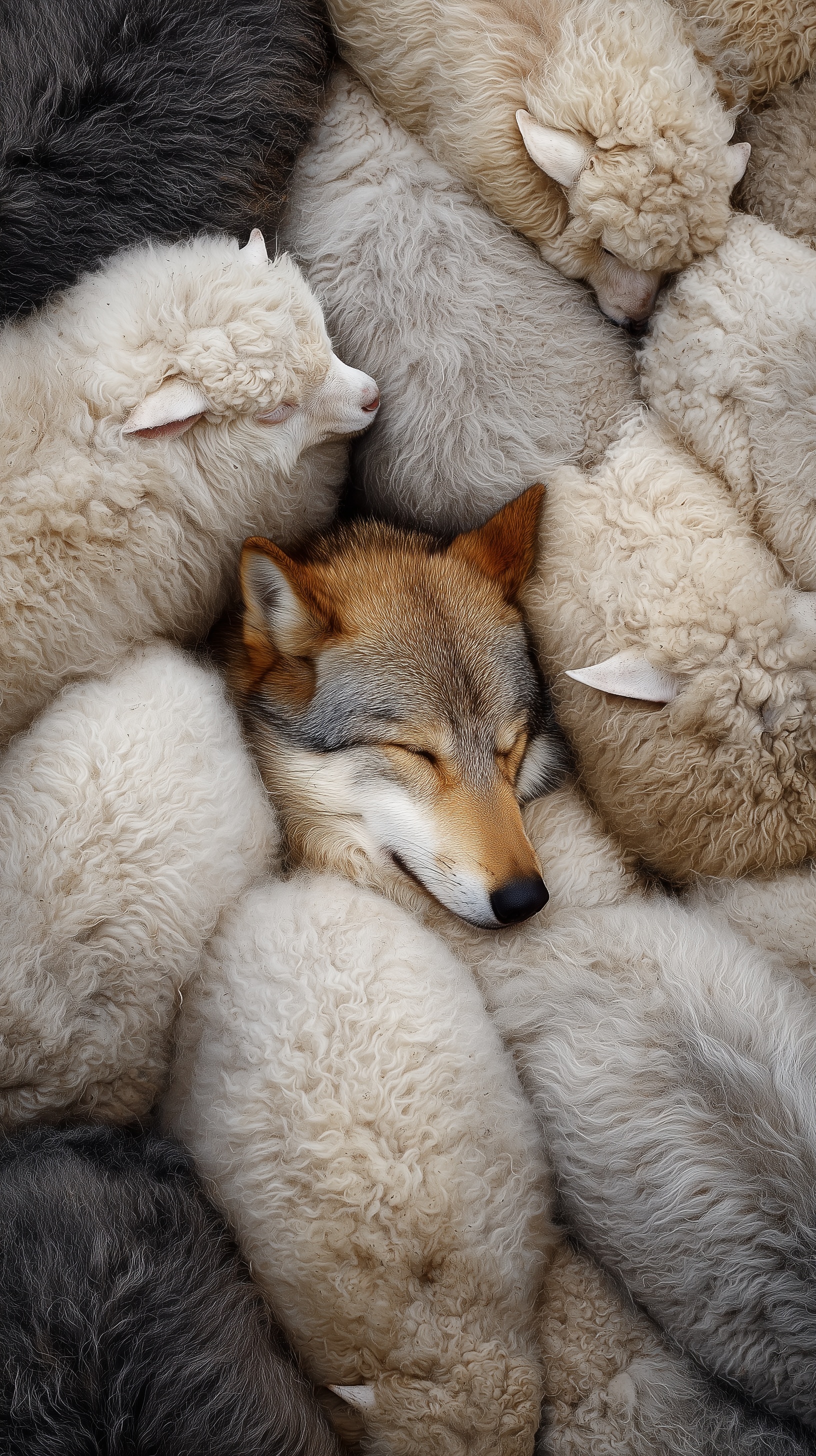
Overhead macro shot of a sleeping timber wolf with eyes gently shut, nestled in a dense circle of curled sheep. The wolf's fur shows rich amber, charcoal, and cream layers with individual guard hairs visible—coarse outer coat transitioning to dense underwool. Surrounding sheep display varied wool textures: tight crimps, loose curls, ivory through grey-black tones with visible lanolin sheen. Soft diffused morning light from upper left creates subtle rim lighting on wolf ear tips and defines wool texture through gentle shadow gradients. Shallow depth of field: f/2.8 equivalent isolates the wolf's peaceful muzzle while sheep in immediate foreground and background fall to soft color-texture masses. Earth-tone palette: warm umber #8B4512, cool grey #708090, muted cream #F5F5DC. Serene, unexpected predator-prey harmony. Extreme detail in fur follicles, wool fiber bundles, and individual keratin scales. 8K, medium format quality, Phase One IQ4 150MP, editorial nature photography. --ar 9:16 --style raw --s 250
Quick Tip: Click the prompt box above to select it, then press Ctrl+C (Cmd+C on Mac) to copy. Paste directly into Midjourney, DALL-E, or Stable Diffusion and customize to make it your own!
Diffusion models do not read a prompt left to right like a human reader. They tokenize the entire string, then weight each token by its position and its distance from the subject noun. In the original wolf prompt, the first six tokens - "Overhead macro shot of a sleeping" - are consumed before the model has any idea what is being photographed. By that point the camera angle, magnification ratio and subject state are already committed to the latent space. Everything that follows is interpreted through that frame. This is the mechanism that separates a usable result from a generic one, and it is the reason the same words in a different order produce a visibly different animal.
The practical consequence is that a prompt is a priority queue, not a description. Tokens near the front receive stronger conditioning during the early denoising steps, when composition and geometry are still fluid. Tokens near the end arrive when the structure is largely fixed and can only nudge surface detail. Moving "sleeping" from token six to token twenty does not change the meaning - it changes how much of the image the model is willing to rebuild to satisfy it. Every element below is analyzed in isolation to show what each parameter actually controls.
Camera and Scale Tokens: Why "Overhead Macro" Sets the Whole Frame
"Overhead" and "macro" are two separate constraints that resolve at different stages of denoising. The angle token fixes the camera on the vertical axis relative to the subject plane, which in this composition means the sheep form a radial ring rather than a horizontal row. The magnification token then sets the field of view narrow enough that the wolf's muzzle occupies roughly one third of the frame height. Remove either one and the image collapses into a conventional wildlife shot: eye-level, wide, with the surrounding animals reading as landscape instead of texture.
The scale relationship matters because it determines what the model treats as surface and what it treats as mass. At macro distance, individual guard hairs are legitimate renderable objects. At medium distance the same fur becomes a single shaded volume. This is the same logic behind tight framing decisions in dramatic feathered portraits, where the crop converts plumage from a silhouette into a field of discrete structures. The wolf prompt inherits that behavior directly from its first two tokens.
Aperture Simulation and the f/2.8 Depth Cue
Diffusion models have no lens, but they have absorbed millions of images tagged with aperture values, and they reproduce the optical signature of those values statistically. Writing "f/2.8 equivalent" activates a specific falloff pattern: a sharp focal plane roughly the width of the wolf's head, with foreground wool and background wool degrading into soft color-texture masses. The word "equivalent" is doing real work here - it signals that the number is a stylistic target rather than a camera setting, which keeps the model from drifting into an oddly literal depiction of lens hardware.
The consequence of shallow depth of field is compositional, not just optical. When the sheep dissolve into blurred wool, they stop competing with the wolf for edge definition. The viewer's eye lands on the only high-frequency region in the frame. That is why the predator reads as calm rather than threatening: no competing detail means no visual alarm. Deeper apertures in the same prompt produce a busy, evenly sharp field where the wolf is merely one textured object among many.
Color Anchoring: Hex Codes as Conditioning Weights
Named colors are ambiguous. "Amber" spans a range from pale honey to deep resin, and the model resolves that ambiguity by sampling toward the most common training association - usually a saturated orange. A hex code removes the sampling step. #8B4512 forces a specific hue, saturation and luminance value into the conditioning, and the model adjusts the amber regions of the wolf's fur to match it. #708090 does the same for the charcoal-grey sections, and #F5F5DC pins the cream undercoat rather than allowing it to drift toward pure white.
Three anchors in the earth-tone family are enough to establish a palette because they cover the warm, cool and neutral axes simultaneously. Adding a fourth or fifth code usually produces muddled transitions, as each new constraint fights the others for influence over the same pixels. The same anchoring discipline appears in impasto night scene work, where a narrow set of pigment references keeps brushstroke color consistent across the canvas. Palette control is always a question of how few anchors you can survive with.
Lighting Direction and the Texture Gradient
"Soft diffused morning light from upper left" is a compound instruction: quality, source and direction. Soft and diffused suppress hard specular highlights, which keeps the wool from reading as plastic. Morning sets a low color temperature, reinforcing the warm umber anchor. Upper left fixes the angle, which is what creates the rim lighting on the wolf's ear tips - the only place in the frame where the light grazes a surface at a shallow enough angle to produce a bright edge.
That rim is not decorative. It separates the wolf's silhouette from the surrounding wool at the exact point where the two textures are most similar in value. Without a directional light source, the ear tips blur into the sheep and the composition loses its focal anchor. The remainder of the lighting job is gradient: shadows falling across the crimped wool define fiber direction, because a curl only reads as a curl when one side of it is darker than the other.
The boundary of this approach is tonal. Hex anchors and directional light work because the palette is narrow and the subject is mid-value. Push the same structure into high-key white or deep low-key black and the anchors stop resolving - the model has no mid-tones left to shift, and the lighting gradient flattens into a single field. The signal that the limit has been crossed is simple: when the rim light on the ear tips disappears and the wool loses its crimp definition, the conditioning has run out of tonal room. At that point the fix is not a stronger prompt but a different exposure range.
Label: Cinematic
Key Principle: Front-load the camera and light before the subject. Tokens read first lock the most parameters; descriptors placed after the noun compete for the same attention budget and dilute the result.
Comments
Post a Comment