A glass serum bottle surrounded by moss and driftwood fails when the prompt treats the container as a single object. Naming each material independently—glass, liquid, chrome, rubber—and anchoring the grammatical subject to the bottle prevents organic textures from absorbing the product's optical definition.
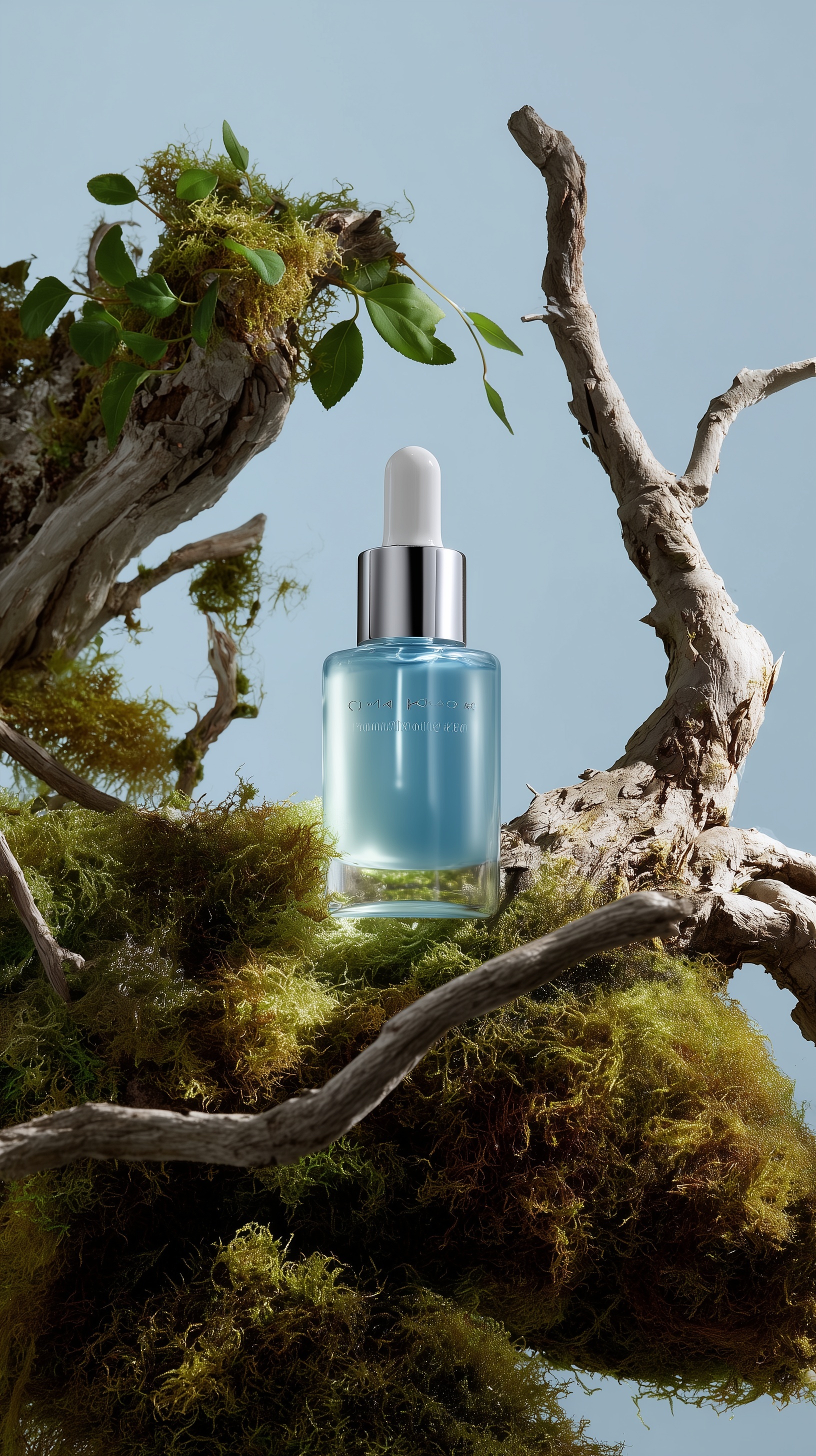
Hyper-photorealistic product shot of a crystal-clear cylindrical glass serum dropper bottle with polished chrome collar and matte white rubber bulb, filled with translucent pale blue liquid showing subtle meniscus curvature. The bottle rests upon a sculptural arrangement of weathered driftwood branches, their surfaces encrusted with vibrant chartreuse moss and delicate new growth leaves with visible venation. Single soft light source from upper left creates defined shadows, caustic reflections through the liquid, and specular highlights on chrome hardware. Background: seamless pale cerulean sky gradient with subtle atmospheric haze. Foreground: out-of-focus moss textures at bottom edge creating natural depth layers. Color story: cool aquamarine liquid, sage and chartreuse moss, weathered driftwood gray-brown, silver metallic accents, pale blue atmosphere. Technical: 85mm lens perspective, f/2.8 shallow depth of field with sharp focus on bottle front plane, center-weighted composition with bottle at upper third intersection, 8K resolution, subsurface scattering visible in liquid, micro-detail on moss sporophytes, commercial beauty photography aesthetic with natural environmental context --ar 3:4 --style raw --v 6.0
A serum dropper bottle is not one object. It is four distinct materials stacked together: a transparent glass cylinder, a column of liquid, a polished chrome collar, and a matte rubber bulb. When a prompt describes the bottle as a single noun, diffusion models tend to average the shading behavior across all four components. The chrome loses its specular reflection, the liquid flattens into an opaque fill, and the glass edges lose their refractive brightening. The result reads like tinted plastic rather than a functional container.
The fix requires naming each component separately and attaching specific optical behaviors to it. "Crystal-clear cylindrical glass" separates the body from the contents. "Translucent pale blue liquid showing subtle meniscus curvature" forces the model to treat the fluid as a transmitting medium with a defined top surface boundary, rather than defaulting to a saturated surface color. Without the word translucent, color terms are frequently interpreted as solid albedo. The meniscus instruction tells the renderer exactly where the fluid stops inside the glass, preventing the liquid from filling the bottle to the brim.
Hierarchy and the first noun phrase
Moss sporophytes, leaf venation, and driftwood grain are high-frequency textures. A clean glass cylinder is low-frequency. If the botanical props occupy too much semantic weight in the prompt, the model allocates detail resolution to the wood and foliage while treating the glass as a background element. The opening phrase dictates this hierarchy. Starting with "product shot of a crystal-clear cylindrical glass serum dropper bottle" anchors the render to the container. Phrases like "rests upon" and "encrusted with" position the driftwood and moss as support structures. Reversing this—"a lush moss bed with a bottle placed on top"—makes the moss the protagonist and shrinks the bottle into a minor detail. Word order controls subject dominance more reliably than any technical parameter.
Lighting for caustics and chrome
A single soft light source from the upper left performs three tasks simultaneously. It casts a shadow that grounds the bottle on the wood. It generates caustic refractions through the pale blue liquid, which is the primary visual cue that the bottle contains fluid rather than solid pigment. It produces a specular highlight on the chrome collar.
Chrome is difficult because it has near-zero diffuse return; it only reflects its environment. If the prompt specifies "polished chrome" without providing something for it to reflect, the metal often renders too dark or too matte. The "seamless pale cerulean sky gradient" in this prompt serves as that reflection source. Connecting the background color explicitly to the metallic hardware gives the model a coherent environment map to draw from. Vague lighting instructions like "soft natural light" distribute illumination evenly and erase the caustics entirely.
Focal length and scale ambiguity
Driftwood and moss have no inherent size reference. Without framing constraints, the bottle could appear two centimeters tall or two meters tall. Specifying an 85mm lens perspective combined with an f/2.8 aperture locks the apparent scale and compresses the background. The shallow depth of field blurs the foreground moss textures at the bottom edge, creating a depth cue that places the bottle close to the camera. Center-weighted composition with the bottle positioned at the upper third intersection prevents the organic props from dominating the frame.
The parameters --ar 3:4, --style raw, and --v 6.0 appended to the original prompt are specific to Midjourney. They control aspect ratio, reduce stylization, and select a particular model version. These flags do not translate to other platforms, and their exact effect depends on the specific service interpreting them. The descriptive text preceding the flags is portable; the flags themselves are not.
Where the technique degrades
Subsurface scattering instructions work well for the liquid and the moss filaments, restoring luminosity that prevents the greenery from reading as flat felt. However, this approach reaches its limit when the product arrangement becomes more complex. A single dropper bottle with four materials can be fully specified in one prompt. Adding a cream jar, a cardboard box, and a printed card to the same driftwood scene exceeds the model's ability to maintain independent material definitions for every object alongside the environmental context. The symptom is predictable: one item renders correctly while the others degrade into approximations. When this happens, adding more tokens does not solve the problem. The reliable alternative is rendering each product separately against the same background description and compositing them afterward.
This process generates a simulation of commercial photography, not a physical photograph. Expect fine details like individual moss spores or precise liquid refraction angles to soften or shift between generations, regardless of the resolution requested in the prompt.
Comments
Post a Comment