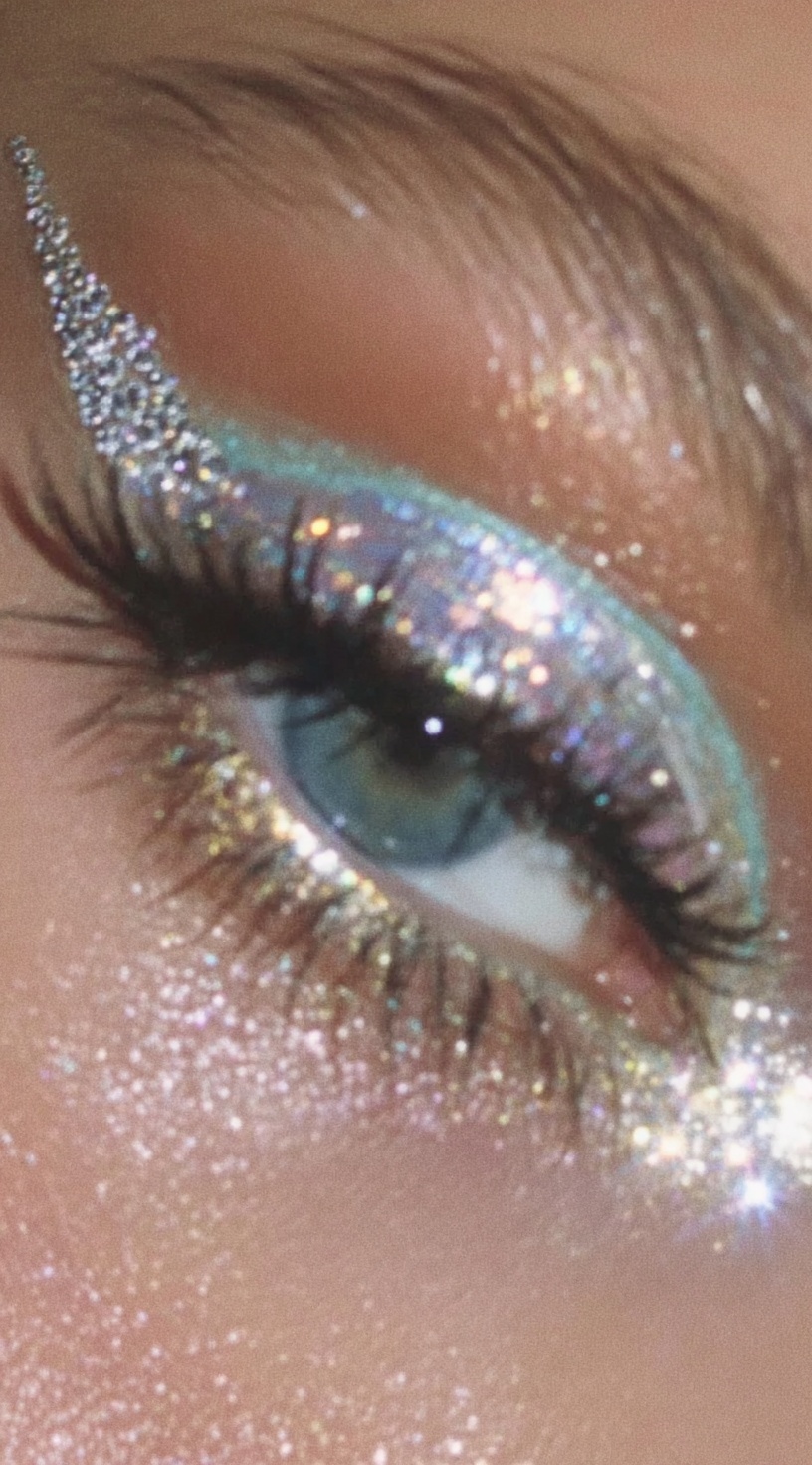
Extreme macro beauty photography of a single human eye, silver holographic glitter winged eyeliner with distinct hexagonal particle structure catching light at multiple angles, duochrome eyeshadow shifting teal base to violet interference peak across mobile eyelid, champagne gold micro-glitter concentrated along lower lash line with sparse scatter toward cheekbone. Individual lashes separated and defined with tapered tips catching rim light. Skin rendered with visible pore structure on lateral canthus, fine vellus hairs on brow bone, natural sebum sheen on orbital ridge. Ring light positioned at 45 degrees creating double hexagonal catchlights in hazel-green iris, large softbox fill at 90 degrees reducing shadow density to 15%. Color palette: molten silver (specular highlights), deep ocean teal (shadow base), warm champagne (transition), electric violet (duochrome shift), neutral warm beige background at 2% luminance. Ethereal glamorous mood, luxury cosmetics campaign aesthetic. Surgical focus depth of field: 3mm plane sharp on lashes and glitter particles, Gaussian bokeh degradation in background. 8K resolution, Hasselblad X2D 100C medium format quality, beauty retouching with preserved texture. --ar 9:16 --style raw --v 6.0
Quick Tip: Click the prompt box above to select it, then press Ctrl+C (Cmd+C on Mac) to copy. Paste directly into Midjourney, DALL-E, or Stable Diffusion and customize to make it your own!
The single most important variable in macro beauty generation is the separation of particle geometry from specular bloom. Most prompts fail because they ask for "glitter" as a singular texture, which the model interprets as a noisy, high-frequency overlay. The mechanism that produces a convincing cosmetic result is defining the physical shape of the particle first, then dictating how light interacts with that shape. When you specify a hexagonal structure, you give the AI a geometric constant to render, preventing the glitter from dissolving into generic white noise or digital static.
This principle holds because diffusion models do not understand "shiny" as a physical property; they understand it as a statistical correlation between high-contrast pixels and specific lighting conditions. If you request a "silver holographic glitter winged eyeliner," the model searches for images of metallic makeup. It will likely produce a flat, reflective strip. To get the iridescent depth seen in luxury campaigns, the prompt must force the model to render the individual facets of the glitter. This is why the original prompt specifies "distinct hexagonal particle structure." It is not a stylistic choice; it is a technical constraint that forces the render engine to resolve geometry before it applies light.
The same logic applies to the duochrome eyeshadow. A prompt that asks for "teal and violet eyeshadow" will result in two separate color patches or a muddy blend. The mechanism of duochrome interference is angle-dependent. To simulate this in a static image, you must describe the transition as a gradient across a curved surface. The prompt uses "teal base to violet interference peak across mobile eyelid." This creates a spatial instruction: the model knows the color must shift based on the curvature of the eyelid. Without this spatial mapping, the AI defaults to a uniform color fill. For a deeper understanding of how curvature and surface interaction drive realism, the principles in this breakdown of porcelain material rendering translate directly to skin and pigment interaction.
Lighting Geometry and the Catchlight Mechanism
The catchlight is the anchor of realism in macro eye photography. It is not merely a reflection; it is a geometric proof of the light source. The prompt specifies a "ring light positioned at 45 degrees creating double hexagonal catchlights." This instruction is crucial because it links the shape of the light modifier to the shape of the reflection. A standard circular softbox produces a round catchlight, which signals a generic studio setup. A hexagonal ring light produces a geometric reflection that implies a specific, high-end modifier. The model uses this catchlight to determine the curvature of the cornea. If the catchlight is too large or too soft, the eye appears flat. If it is too sharp, the eye appears glassy and artificial.
Managing the fill light is equally critical for maintaining texture. The prompt calls for a "large softbox fill at 90 degrees reducing shadow density to 15%." This is a precise instruction to prevent the shadows from crushing the micro-detail. In macro beauty, the lateral canthus and the lower lash line are the areas where skin texture is most visible. If the shadow density is high, the model will render these areas as smooth, plastic surfaces to avoid noise. By reducing the shadow density to 15%, you force the AI to retain the pore structure and vellus hairs. This creates the "natural sebum sheen" mentioned in the prompt, which is the hallmark of a high-end retouched image rather than a raw render.
The interaction between the glitter and the skin is where most generations break down. The prompt specifies "champagne gold micro-glitter concentrated along lower lash line with sparse scatter toward cheekbone." This is a density gradient instruction. If you ask for glitter on the cheek, the model will often apply it as a uniform mask. By specifying "sparse scatter," you are telling the AI to reduce the particle count in a specific direction. This mimics the physics of adhesion: larger particles stick to the lash line, while finer particles drift outward. This level of control requires a deep understanding of how prompt weighting affects spatial distribution. The techniques for managing complex material interactions in this guide to feathered textures are applicable here, as both rely on controlling the falloff of a texture across a surface.
The depth of field is another area where the mechanism must be explicitly defined. The prompt uses "surgical focus depth of field: 3mm plane sharp on lashes and glitter particles." This is a physical camera instruction. It tells the model that the focal plane is extremely narrow. Without this, the AI will attempt to render the entire eye in sharp focus, which results in a flat, clinical look. By defining the 3mm plane, you force the background into "Gaussian bokeh degradation." This separation is what creates the "ethereal glamorous mood." The bokeh must be soft, but it must also be structured. The prompt specifies "neutral warm beige background at 2% luminance." This is a low-contrast background that prevents the eye from being overwhelmed by environmental noise. It allows the specular highlights on the glitter to pop without competing with background details.
Color Palette and the Physics of Interference
The color palette is not a list of colors; it is a set of physical states. "Molten silver" represents the specular peak. "Deep ocean teal" represents the shadow base. "Electric violet" represents the duochrome shift. "Warm champagne" is the transition. When you assign these colors to specific lighting conditions, you are essentially writing a shader for the AI. The model uses these anchors to determine how the light bends across the eye. If you simply list "teal, violet, silver," the model will mix them randomly. By assigning them to "specular highlights," "shadow base," and "interference peak," you create a logical hierarchy. This hierarchy is what makes the image look like a photograph rather than a digital painting.
The "Hasselblad X2D 100C medium format quality" reference is a shorthand for a specific sensor response. Medium format sensors have a different dynamic range and color depth than full-frame sensors. They render transitions more smoothly and retain more highlight detail. When you include this in the prompt, you are telling the model to prioritize tonal gradation over sharpness. This is particularly important for the "silver holographic glitter." A full-frame look might render the glitter as harsh, isolated points of light. A medium format look will render the glitter as a cohesive, shimmering surface with softer specular roll-off. This subtle difference is what separates a generic AI image from a campaign-ready asset.
The final piece of the puzzle is the "beauty retouching with preserved texture" instruction. This is a conflict resolution directive. AI models tend to over-smooth skin when asked for "beauty." To prevent this, you must explicitly ask for "visible pore structure" and "fine vellus hairs." The model then understands that the retouching should be frequency separation, not blurring. This is a common failure point in commercial prompts. If you do not specify texture retention, the AI will default to a plastic, mannequin-like finish. By demanding pore structure on the lateral canthus and sebum sheen on the orbital ridge, you force the model to render the skin as a living organ, not a surface. This is the difference between a technical demo and a professional beauty campaign.
To refine this further, consider how the model handles the "duochrome" shift. The interference peak is the most difficult element to control. It relies on the angle of incidence. The prompt states "shifting teal base to violet interference peak across mobile eyelid." The "mobile eyelid" is the key. It is a curved surface. The model must calculate the normal vector of that surface to place the violet peak correctly. If the eyelid is rendered as flat, the violet will be a stripe. If it is rendered with proper curvature, the violet will be a soft gradient that follows the contour. This is why the prompt emphasizes "across mobile eyelid." It is a spatial constraint that forces the AI to respect the anatomy. When this works, the result is a hypnotic, shifting color that looks physically accurate.
Execution Parameters and Model Variance
The parameters `--ar 9:16 --style raw` are essential for this specific composition. The 9:16 aspect ratio is vertical, which is standard for mobile-first beauty campaigns and social media. It allows the eye to fill the frame without excessive cropping. The `--style raw` flag is critical because it reduces the model's tendency to apply artistic stylization. In beauty photography, you want the raw sensor look, not a painterly interpretation. The raw style preserves the high-frequency detail of the glitter and the skin texture. Without it, the model may apply a soft, dreamy filter that destroys the hexagonal particle structure. The `--s 250` (stylize) parameter is moderate. It provides enough aesthetic guidance to keep the image glamorous but not so much that it overrides the technical instructions.
The "8K resolution" and "Gaussian bokeh degradation" are not just quality tags; they are focus instructions. The 8K tag tells the model to render fine detail, while the bokeh instruction tells it to blur the background. This combination creates a specific "look" that is associated with high-end macro photography. The model must understand that the sharpness is localized. If the entire image is 8K sharp, it looks like a stock photo. If the background is bokeh and the foreground is sharp, it looks like a captured moment. This is the difference between a diagram and a photograph. The "surgical focus" instruction reinforces this by defining the exact plane of sharpness. It is a precise, technical approach that yields a precise, technical result.
What still depends on the specific model version is the interpretation of "hexagonal particle structure." Newer models with higher training on microscopic imagery may render the hexagons accurately. Older or more stylized models may interpret "hexagonal" as a general sparkle pattern. If the hexagons are not visible, the prompt may need to be strengthened with "macro lens" or "microscopic detail." The trade-off is always between aesthetic beauty and technical accuracy. For a campaign, you need both. The prompt must balance the glamour of the "molten silver" with the physics of the "hexagonal structure." When these two elements align, the image transcends a simple render and becomes a convincing piece of visual art.
The core principle that controls everything above is that light must be defined by the geometry it interacts with. You cannot prompt for "glitter" and expect realism; you must prompt for the shape of the particle and the angle of the light. Every parameter, from the catchlight shape to the duochrome shift, is a function of this relationship. When you control the geometry, you control the light. When you control the light, you control the realism.
Label: Fashion
Key Principle: To achieve photorealistic glitter, you must separate particle geometry from specular bloom. Define the hexagonal structure first, then use lighting angles to create the interference shift.
Comments
Post a Comment