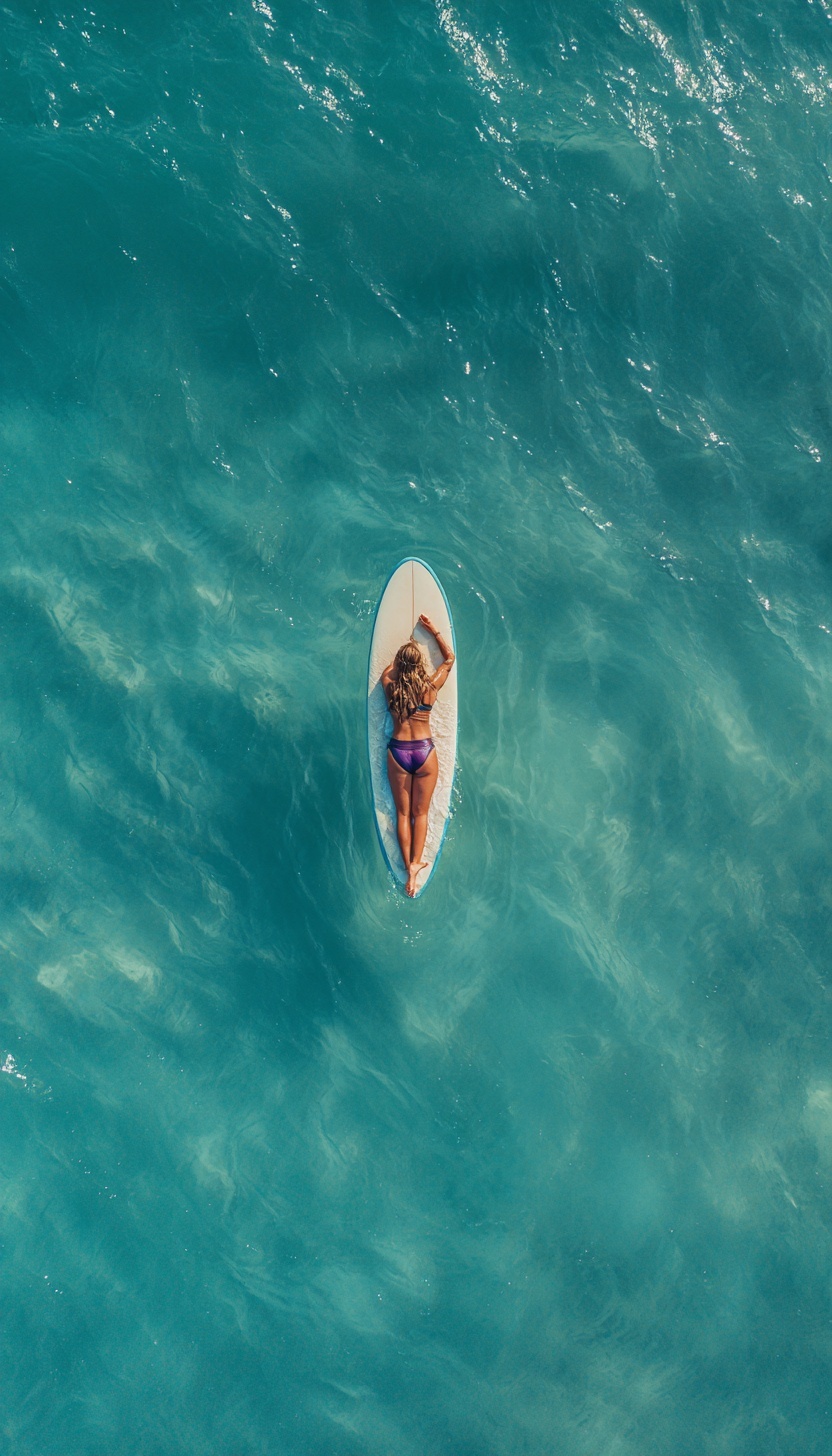
Drone photography, extreme high-angle top-down view (85°-90° nadir), athletic woman with sun-bleached wavy blonde hair fanning in water, wearing saturated violet high-cut bikini, lying prone paddling on sleek white surfboard with subtle cyan rail edge. Centered composition against endless gradient turquoise ocean — deep teal shadows in wave troughs shifting to aquamarine shallows, visible underwater sand patterns through translucent water. Harsh midday Mediterranean sun at 5500K creates dancing specular highlights on surface ripples, sharp shadow beneath board. Photorealistic 8K, shot on Hasselblad X2D 100C with 24mm equivalent lens, travel editorial for Condé Nast Traveler, hyperdetailed water caustics, subtle film grain texture, color graded warm-cool split with teal shadows and amber highlights. Mood: solitary focus, anticipation, salt-stained freedom. --ar 9:16 --style raw --s 50 --q 2
Quick Tip: Click the prompt box above to select it, then press Ctrl+C (Cmd+C on Mac) to copy. Paste directly into Midjourney, DALL-E, or Stable Diffusion and customize to make it your own!
Two aerial surf renders can use identical subject phrasing, identical bikini color codes, and identical ocean vocabulary, yet one reads as a genuine drone frame and the other as a flat graphic. The difference is rarely the model. It is whether the prompt locks the camera elevation, the water translucency ratio, and the specular ceiling before the subject is ever described. When elevation sits at 85°-90° nadir and translucency is expressed as a visible depth cue, the frame reads as photography. When those three anchors are absent, the ocean flattens into a teal wallpaper and the board floats without weight.
That gap is not stylistic. It is structural, and it is measurable in the output. The paragraphs below break the aerial surf prompt into three architectures — flat nadir, angled three-quarter, and hybrid — and show what each one produces, what it costs, and where it fails. The goal is not a single "best" prompt but a decision framework: pick the approach that matches the shot you need, then tune the parameters inside it.
Approach 1: Flat Nadir (85°-90°)
Flat nadir places the camera directly overhead, so the vertical axis of the frame maps onto the ocean surface with no horizon line. This is the geometry in the reference image: board centered, body aligned vertically, water filling every edge. The mechanism is simple — without a horizon, the eye has no depth reference except the water itself, which is why translucency becomes the entire depth system. If the water is opaque, the frame reads as a printed pattern. If it is translucent, sand patterns and submerged reef structure provide the parallax the horizon would normally supply.
The trade-off is compositional rigidity. A strict nadir forces symmetry, and symmetry is unforgiving: any drift off-center in the subject or the board becomes immediately visible. It also removes the sky entirely, which eliminates atmospheric cues like sun flare or haze. For a travel editorial look, that austerity is often the point — it isolates the swimmer and the water into a single graphic unit. The parameter that matters most here is the shadow beneath the board, described as sharp rather than soft, because a soft shadow at 90° reads as a compositing error rather than a lighting condition.
Translucency should be written as a depth range, not an adjective. "Visible underwater sand patterns through translucent water" gives the model a physical cue: it must render submerged geometry that is partially occluded by surface ripples. That phrasing is what pushes the water from flat color into a volumetric medium. The same logic appears in hyper-realistic product renders, where surface and subsurface behavior must be described separately or the material collapses into a single flat tone.
Specular highlights are the failure point of flat nadir. At 5500K midday light, ripples produce hundreds of small blown highlights, and models tend to over-render them into a white noise field that destroys the turquoise gradient. The fix is a ceiling: describe "dancing specular highlights on surface ripples" rather than "glittering water," and pair it with a color grade that keeps shadows in deep teal. This is a balance problem, not a brightness problem — the same tension between highlight control and saturation appears in impasto night scene prompts, where specular energy has to be bounded or the frame clips.
Approach 2: Angled Three-Quarter (55°-70°)
Dropping the camera to 55°-70° reintroduces a partial horizon and a visible water-to-sky transition at the top of the frame. The mechanism changes entirely: depth is now carried by perspective compression rather than by translucency, because the receding water plane creates its own vanishing structure. The subject reads as smaller and more embedded in the environment, and the board's rail edge becomes visible along its length instead of only at the tail.
This approach is more forgiving of compositional drift. Because the horizon anchors the frame, an off-center subject still reads as intentional placement rather than a rendering error. It is also more flexible for narrative: you can imply motion toward the horizon, which flat nadir cannot do without breaking the overhead logic. The cost is that you lose the graphic purity of the nadir view. The surfboard's clean silhouette — the strongest visual element in the flat version — is foreshortened, and the water occupies less of the frame.
Water translucency still matters at this angle, but its role shifts from primary depth carrier to secondary texture. The sand patterns visible through the water now function as evidence of shallowness rather than as the spatial backbone. If you keep translucency phrasing at the same intensity as in a nadir prompt, the water can over-render and compete with the subject. Reducing it to a subtle cue — visible only in the lower third of the frame — restores hierarchy.
Highlight behavior also changes. At 60°, the sun's reflection path across the water becomes a directional streak rather than an even field, which gives the image a natural leading line. That streak is useful, but it must be controlled: if the prompt does not specify the highlight as directional, the model tends to distribute it evenly and flatten the light back into a generic sheen. Naming the direction — "reflection path running from lower left toward the subject" — is what converts it into a compositional asset.
Approach 3: Hybrid — Nadir Geometry with Angled Light
The hybrid approach keeps the 88°-90° nadir camera but describes the light as if it were arriving at an angle. This is not physically contradictory; it is a way of separating geometry from illumination so the model does not couple them. The result is a flat, graphic overhead composition with a directional highlight streak across the water — the purity of nadir plus the leading-line light behavior of an angled shot.
This is the most controllable of the three architectures, and also the most fragile. Because the camera and light descriptions no longer agree geometrically, the model has to be told explicitly to preserve the overhead perspective. Phrases like "camera directly overhead, light raking across the surface from the upper right" hold the two systems apart. Without that separation, the model defaults to a coherent scene — meaning it will bend the camera toward the light direction and quietly convert the nadir into a 70° angle.
The hybrid is best suited to editorial work where the board and swimmer need to stay centered and symmetrical, but the water needs directional energy rather than even sparkle. It also gives the strongest board shadow, because the angled light produces a defined cast shadow directly beneath the deck while the top-down camera keeps that shadow visible in full. In a true angled shot, the same shadow would be partially hidden by the board itself.
For consistency across a set, the hybrid is the hardest to reproduce — it depends on the model respecting an intentionally inconsistent scene description, which is exactly the kind of instruction that drifts between seeds. The practical mitigation is to lock the aspect ratio and style flags and keep the light direction phrase identical across every variation, so the only variable is the subject description. Broad parameter discipline of this kind is the same principle that governs dramatic feathered portrait work, where a single locked lighting descriptor prevents the entire set from fragmenting.
What to Verify Before Accepting the Frame
Run these checks in order. Each one takes seconds and catches the failure that matters most at that stage.
One: confirm the camera elevation. If any horizon line or sky band appears at the top edge of a nadir prompt, the model has drifted below 85° and the overhead logic is broken. Two: check the water for a visible depth cue. If the ocean reads as a single flat teal field with no submerged pattern or trough shadow, translucency was not rendered and the frame is graphic, not photographic.
Three: inspect the specular highlights. If ripple sparkle has merged into continuous white patches, the highlight ceiling was exceeded and the turquoise gradient is compromised. Four: verify the board shadow. It should be sharp and directly beneath the deck; a soft or offset shadow means the lighting description contradicted the camera position. Five: check subject alignment against the board axis. In nadir compositions, any lateral drift of the body off the board's centerline breaks the symmetry the geometry demands.
Six, and last: confirm the color grade holds. Shadows should sit in deep teal, highlights in warm amber, with no neutral gray midtones creeping in. If the midtones have drifted toward gray, the split grade was not applied and the water will read as generic blue rather than Mediterranean turquoise. Passing all six means the prompt architecture held; failing any one points to the specific parameter that needs tightening before the next render.
Label: Cinematic
Key Principle: Nadir angles below 85° introduce horizon artifacts. Lock the camera elevation, define water translucency as a percentage, and cap specular intensity to prevent blown highlights.
Comments
Post a Comment