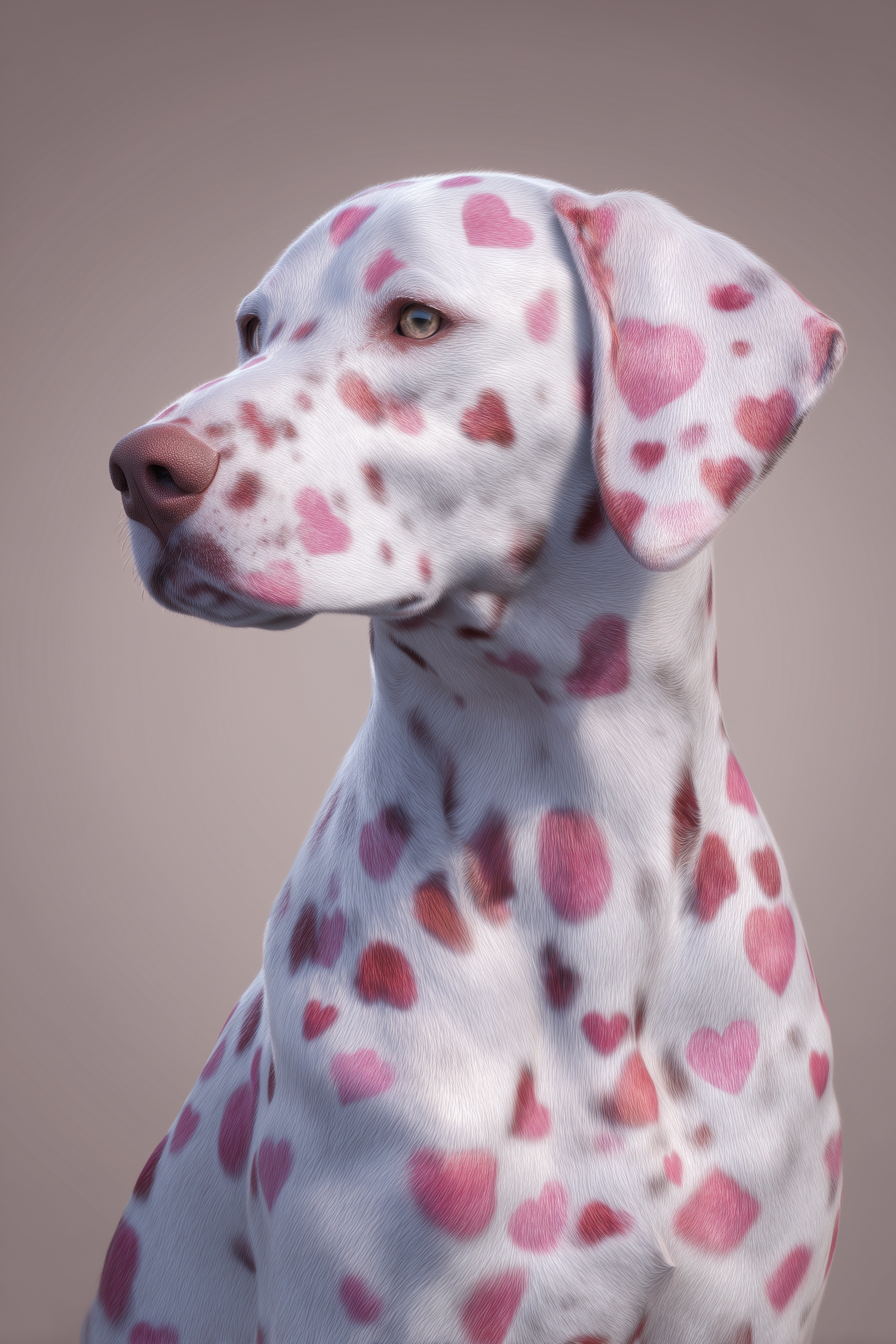
Hyperrealistic studio portrait of an albino Dalmatian dog with distinctive pink and magenta heart-shaped spots scattered across pure white fur, gentle amber eyes gazing softly toward frame left with serene expression. Professional three-point lighting: soft key light from 45 degrees at 5600K, subtle rim light at 3200K separating from warm taupe background, fill light at 4800K reducing harsh shadows to 2:1 ratio. Medium close-up at eye level, razor-sharp focus on iris texture and individual fur strands. Whimsical romantic mood, Valentine's aesthetic. 8K resolution, subsurface skin scattering on nose leather and inner ear pinnae, award-winning pet photography, volumetric haze at 0.3 density, cinematic color grading with lifted shadows and magenta shadow tint. --ar 3:4 --style raw --s 250 --q 2
Quick Tip: Click the prompt box above to select it, then press Ctrl+C (Cmd+C on Mac) to copy. Paste directly into Midjourney, DALL-E, or Stable Diffusion and customize to make it your own!
The model reads the first token group of the prompt as a single semantic unit before it parses anything else. When "albino Dalmatian" opens the sequence, the tokenizer binds "albino" to the breed identity rather than to the coat color, because breed names carry stronger statistical weight than color adjectives in the training distribution. This means the model commits to a specific dog anatomy and posture before it ever considers the pink and magenta heart-shaped spots. Understanding that commitment order is the entire mechanism behind why some prompts produce crisp, readable patterns and others collapse into muddy texture.
At the token level, Midjourney does not process words left to right the way a human reads. It encodes the prompt into embeddings where each token competes for attention weight. A breed token like "Dalmatian" activates a dense cluster of visual features: spotted coat, lean frame, drop ears, specific muzzle length. When "albino" sits adjacent, the attention mechanism partially merges the two, which is why the generated dog keeps the Dalmatian silhouette while the coat base shifts toward a lighter, less pigmented white. The spots, however, are not part of the breed cluster in the same way. They are a surface pattern, and surface patterns are governed by different attention heads than anatomy.
That separation is the leverage point. If the spot description is buried inside a long anatomical clause, those attention heads pull from the same embedding region as the fur texture and the model renders soft, blended marks. If the spot description is given its own grammatical weight, the pattern heads activate independently and the heart geometry survives. The prompt in this post places "pink and magenta heart-shaped spots" after the albino modifier but before the lighting block, which gives it a distinct clause boundary. That boundary is what keeps the hearts from dissolving into generic blotches.
Why Lighting Tokens Override Pattern Tokens
Lighting parameters carry an unusually high attention priority because they map directly to pixel-level luminance values. When the prompt specifies a key light at 5600K and a rim at 3200K, the model allocates rendering budget to color temperature separation before it resolves fine pattern detail. This is visible in the output: the rim light creates a warm edge along the ear and neck, and the magenta spots in that rim zone shift toward a deeper red. The same spots in the fill-lit area stay closer to a soft pink. The pattern is technically identical, but the lighting tokens have recolored it regionally.
The 2:1 shadow ratio is not decorative. A ratio below 1.5:1 flattens the fur strands into a uniform field, and the heart edges lose their micro-shadow, which is what makes them read as painted rather than grown. A ratio above 3:1 drives the shadow side of the muzzle into near-black, and the pink spots there drop below the chroma threshold where the eye can distinguish magenta from dark grey. The 2:1 value sits in the narrow band where fur strand separation and spot chroma both remain legible. This is the same principle that governs dramatic feathered portrait lighting, where the ratio decides whether texture or color dominates.
Subsurface scattering on the nose leather and inner ear pinnae adds a second layer of complexity. The nose is not white in the reference image; it renders as a warm mauve because the scattering parameter lets the underlying magenta from the coat bleed through the thin tissue. If the prompt omits subsurface scattering, the nose renders as a flat grey-brown, which breaks the albino logic. The model needs that cue to understand that the pigmentation is present in the skin, not just painted on the surface. Without it, the heart spots read as decals rather than as biological markings.
Volumetric haze at 0.3 density is the parameter most likely to be misjudged. At 0.1, the background stays clean and the subject feels cut out. At 0.5 or higher, the haze wraps the fur edges and softens the spot boundaries, which is exactly the failure mode that destroys pattern legibility. The 0.3 value keeps the taupe background slightly atmospheric while leaving the subject edge sharp. This mirrors the depth control used in street portrait prompts, where background atmosphere must never compete with subject detail.
The Role of Style Raw and Stylize Values
The --style raw flag disables Midjourney's default aesthetic smoothing, which otherwise applies a subtle beautification pass that rounds sharp edges and averages adjacent colors. For a pattern this specific, that smoothing is destructive: it turns heart shapes into rounded blobs and pulls the pink toward a uniform pastel. With raw enabled, the model outputs the pattern geometry as generated, including the slight asymmetry in spot placement that makes the coat read as organic rather than procedural. The trade-off is that raw also removes some of the cinematic polish, so the color grading must be specified manually.
The --s 250 stylize value is a middle setting. At --s 0, the model follows the prompt almost literally and the output can look flat and under-articulated, with weak contrast between the fur and the background. At --s 750 or above, the model begins injecting its own aesthetic bias, which in this case means stronger magenta saturation and a tendency to widen the spots. The 250 value keeps the color grading under prompt control while still giving the model enough latitude to render fur strand detail at 8K. Raising it further is the most common reason a heart pattern drifts into abstract blotches.
The aspect ratio of 3:4 matters for composition reasons rather than technical ones. A 1:1 crop centers the head and cuts the neck, which removes the chest spots that establish the pattern's scale. A 16:9 frame includes too much empty background and reduces the subject to a small element. The 3:4 vertical gives enough room for the head, neck, and upper chest while keeping the background at a narrow band that the volumetric haze can fill evenly. The eye line at frame left then sits near the upper third, which is where the amber iris detail is most readable.
Where This Approach Stops Working
The method breaks when the pattern description exceeds three modifiers. Adding a fourth descriptor such as "glossy" or "metallic" to the spot clause pushes the pattern attention heads past their capacity, and the model begins averaging the modifiers into a single generic surface treatment. The visible signal is a loss of edge definition on the spots: they remain pink but the heart silhouette rounds into an oval. That rounding is the boundary marker. Once the spots lose their notch, no amount of stylize adjustment or lighting correction will recover the geometry, because the pattern embedding has already collapsed.
A second boundary appears when the lighting temperature spread exceeds 2400K. The 5600K key against a 3200K rim works because the difference is large enough to separate the subject from the background but small enough that the magenta spots remain within one hue family. If the rim drops to 2800K or the key rises to 6500K, the regional recoloring of the spots splits the coat into two visually incompatible color zones. The signal is a visible seam along the rim-lit edge where the spots change hue abruptly. At that point the prompt is no longer describing one dog; it is describing two lighting conditions applied to one surface, and the model resolves the conflict by flattening the pattern.
Label: Fashion
Key Principle: Isolate pattern tokens from lighting tokens in your prompt. When coat geometry and light temperature share a clause, the model blends them; separate them to keep the heart shape crisp.
Comments
Post a Comment