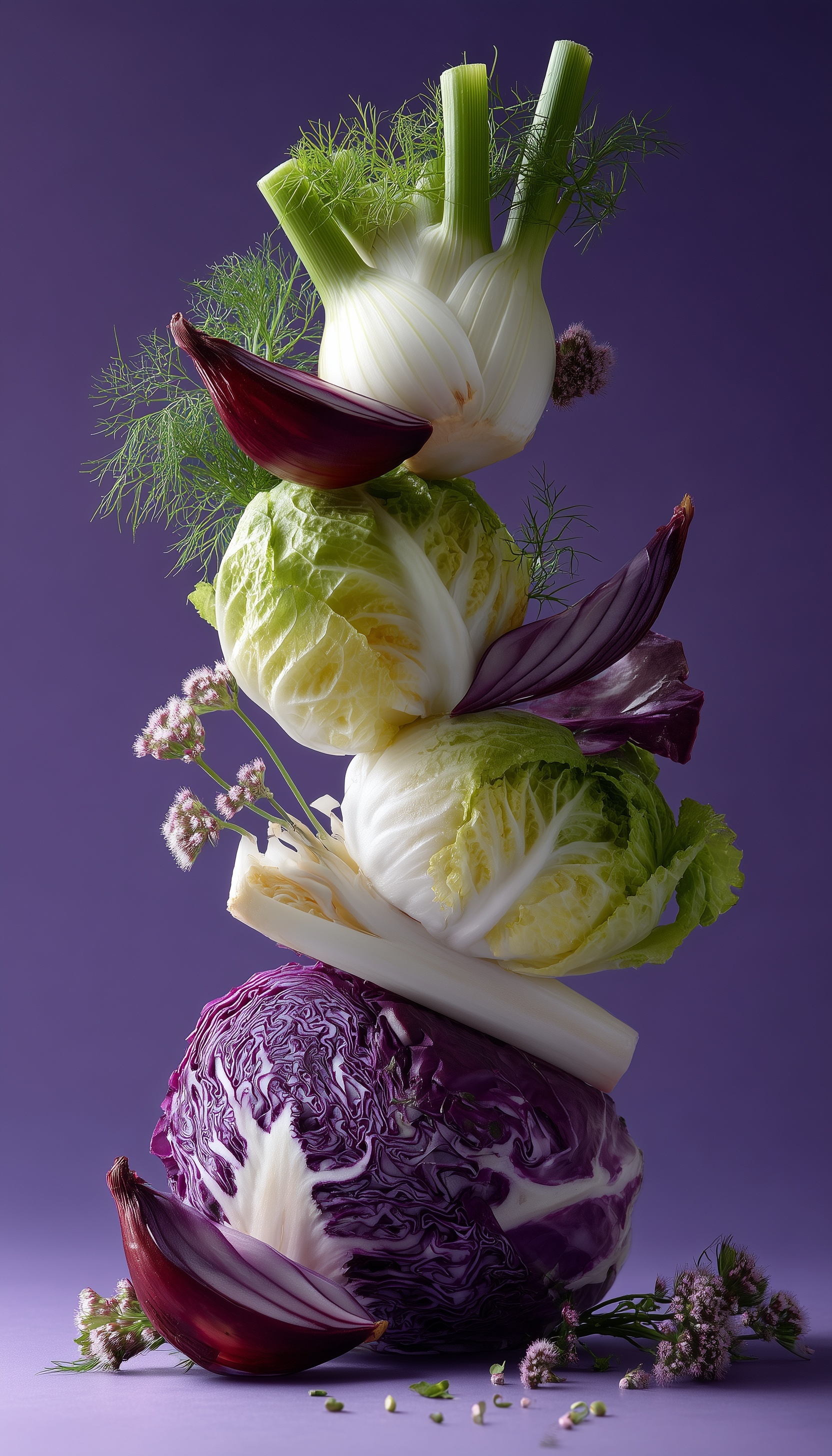
Vertical tower of fresh vegetables in perfect equilibrium against seamless lavender-purple backdrop (RGB 138, 102, 178). Summit: two fennel bulbs with feathery fronds, backlit to create translucent glow through pale green stalks. Upper midsection: pale green Napa cabbage with crisp layered leaves, cross-lit to emphasize leaf dimensionality. Central bridge: thick white leek segment, cylindrical, smooth surface catching soft specular highlight. Foundation: dramatic half red cabbage revealing intricate internal veining, purple-white marbling, cut surface facing camera. Scattered accents: crimson onion wedges with translucent layers visible, tiny purple chive blossoms with fuzzy spherical blooms at base. Eye-level camera, portrait orientation 9:16. Studio lighting: 5-foot octabox key light at 45 degrees camera left, fill card at 1:4 ratio camera right, background lit separately to eliminate gradient. Shallow depth of field: f/2.8 equivalent, tower razor-sharp, foreground blossoms soft circles of confusion. 8K, hyper-detailed surface textures showing individual epidermal cells, fresh water droplets with caustic highlights, professional color grading with lifted blacks, commercial advertising quality --ar 9:16 --style raw --v 6
Quick Tip: Click the prompt box above to select it, then press Ctrl+C (Cmd+C on Mac) to copy. Paste directly into Midjourney, DALL-E, or Stable Diffusion and customize to make it your own!
Most prompts for vertical food towers fail because they describe the wrong variable. The instinct is to spend the token budget on the vegetables themselves, listing fennel, Napa cabbage, leek, red cabbage, and chive blossoms in exhaustive detail. The model renders all of them, correctly, and the image still looks flat. The reason is that AI image models trained on commercial photography have learned that a stacked composition is really a lighting problem disguised as a subject problem. When the lighting language is vague, the model defaults to a soft, even fill that flattens every surface into the same matte value. The vegetables are there; the dimensionality is not.
The fix is not more adjectives about freshness. It is replacing positional lighting language with physical lighting language. "Key light at 45 degrees camera left" tells the model where a lamp is. "Backlit to create translucent glow through pale green stalks" tells the model what the light does when it hits that specific material. The second phrasing carries three times the rendering information because it encodes direction, material response, and visible outcome in one clause. This is the core mechanic behind the lavender-backdrop still life approach used in organic product photography workflows, where surface behavior matters more than subject inventory.
What the Element Actually Is
A vertical vegetable tower is a structural prompt, not a subject prompt. The model is not being asked to invent a composition; it is being asked to respect a vertical stack with defined load-bearing relationships. That distinction matters because Midjourney and comparable engines handle structural constraints differently from descriptive ones. When the prompt specifies "perfect equilibrium" and identifies a summit, a midsection, a bridge, and a foundation, the model treats those as spatial anchors rather than decorative suggestions.
The lavender backdrop at RGB 138, 102, 178 is doing more work than most writers realize. That specific hue sits opposite the yellow-green of Napa cabbage on the color wheel, which forces the cabbage leaves to read as luminous rather than muddy. If the backdrop drifts toward neutral grey or warm beige, the pale greens collapse into the same value range as the background and the tower loses its silhouette. Specifying the RGB value directly removes that ambiguity and locks the contrast relationship.
The foundation element, a half red cabbage with cut surface facing camera, functions as the visual anchor. The internal veining and purple-white marbling give the eye a high-frequency texture zone at the base, which stabilizes the composition. Without that density at the bottom, vertical towers tend to feel top-heavy and the model often compensates by widening the upper elements, breaking the equilibrium the prompt requested.
The leek segment functions as a structural bridge rather than a vegetable. Its cylindrical form and smooth surface provide a low-frequency visual rest between the chaotic Napa cabbage above and the dense red cabbage below. This is the element most often omitted by writers who treat the tower as a list of produce instead of a rhythm of textures. The result is a stack that reads as cluttered rather than composed.
How the Model Interprets the Prompt
When the prompt says "5-foot octabox key light at 45 degrees camera left," the model does not simulate a physical octabox. It retrieves training data associated with that lighting descriptor, which in commercial food photography correlates with soft-edged shadows, gradual falloff, and a specific specular highlight shape on curved surfaces. The phrase is a retrieval key, not a physics instruction. Understanding this changes how the prompt should be written: the goal is not accuracy but recognizability to the training distribution.
The fill card at 1:4 ratio matters for the same reason. That ratio is the standard commercial convention for food photography, and it tells the model to keep shadow detail visible without flattening the contrast. Prompts that omit the fill ratio often produce images where the shadow side of the tower goes pure black, which reads as dramatic but kills the surface texture on the leek and the onion wedges. The 1:4 convention preserves both contrast and detail, which is why it appears in nearly every professional food photography reference set.
Background lit separately to eliminate gradient is a deceptively important clause. Without it, models tend to apply the same key light logic to the backdrop, which creates a visible falloff from the tower base to the frame edges. That gradient looks intentional in moody portraiture but reads as sloppy in product work because it competes with the subject for attention. Isolating the background lighting collapses the backdrop into a uniform color field, which is what commercial packaging photography actually looks like.
The depth-of-field instruction at f/2.8 equivalent works because the model has learned to associate that aperture with foreground and background separation at a specific subject distance. The clause "foreground blossoms soft circles of confusion" reinforces this by naming the exact artifact the model should produce. Without that reinforcement, shallow depth-of-field prompts on still life often render with a uniform sharpness that reads as computational rather than photographic. For comparison, the same separation logic applies in hyper-realistic floating food compositions, where the subject is similarly isolated against a seamless field.
Edge Cases and Version Behavior
The single largest variable in reproducing this prompt across sessions is model version. Midjourney v6 handles the material-specific lighting clauses with noticeably more fidelity than v5.2, particularly the translucent glow through fennel stalks and the caustic highlights on water droplets. On earlier versions, those clauses are often ignored in favor of a generic soft-light interpretation. The prompt should be treated as version-locked, and results compared only within the same engine build.
Water droplets are the most fragile element in the prompt. The clause "fresh water droplets with caustic highlights" produces accurate results only when the model already has strong material priors for the surface beneath them. On the smooth leek, droplets render cleanly. On the feathery fennel fronds, the model often produces droplet artifacts that read as noise or lens dirt. In practice, the safest approach is to specify droplets only on the leek and cut cabbage surfaces, leaving the fronds dry.
The chive blossoms with fuzzy spherical blooms are the second fragile element. The allium family has a distinctive spherical umbel structure, and models trained on limited botanical data sometimes render them as generic purple clusters or, worse, as pom-pom shapes borrowed from decorative flowers. Adding "umbel" or "allium" as a secondary descriptor improves fidelity, though it can push the model toward ornamental allium rather than chives. This is one of the trade-offs that still depends on the specific model version and cannot be fully resolved by prompt wording alone.
Removing the background gradient is not always desirable. Some brand applications specifically want a soft vignette behind the subject to suggest a physical studio space rather than a digital void. In those cases, dropping the "background lit separately" clause and instead specifying "graduated backdrop from RGB 138, 102, 178 to RGB 110, 80, 150" gives the model a controlled gradient target rather than an accidental one. The difference between intentional and accidental gradient is entirely in whether the prompt names both endpoint colors.
The next variation worth trying is rotating the entire tower 90 degrees into a horizontal composition while keeping every lighting clause identical. The expected result is that the model redistributes weight along the horizontal axis and the octabox key light now rakes across the length of the leek bridge instead of across its diameter. That single change tests whether the lighting language is doing the work or whether the vertical structure was carrying the image. If the horizontal version still reads as commercial-grade, the prompt is structurally sound. If it collapses into a cluttered pile, the vertical constraint was doing more than it appeared to.
Label: Product
Key Principle: Stop describing light direction and start describing light physics. Terms like "backlit," "cross-lit," and "specular highlight" tell the model how surfaces should react, not just where the lamp sits.
Comments
Post a Comment