Generating a branded playing card character requires replacing abstract quality labels with specific material behaviors, anchoring split-costume boundaries to physical seams, and planning typography placement for manual correction.
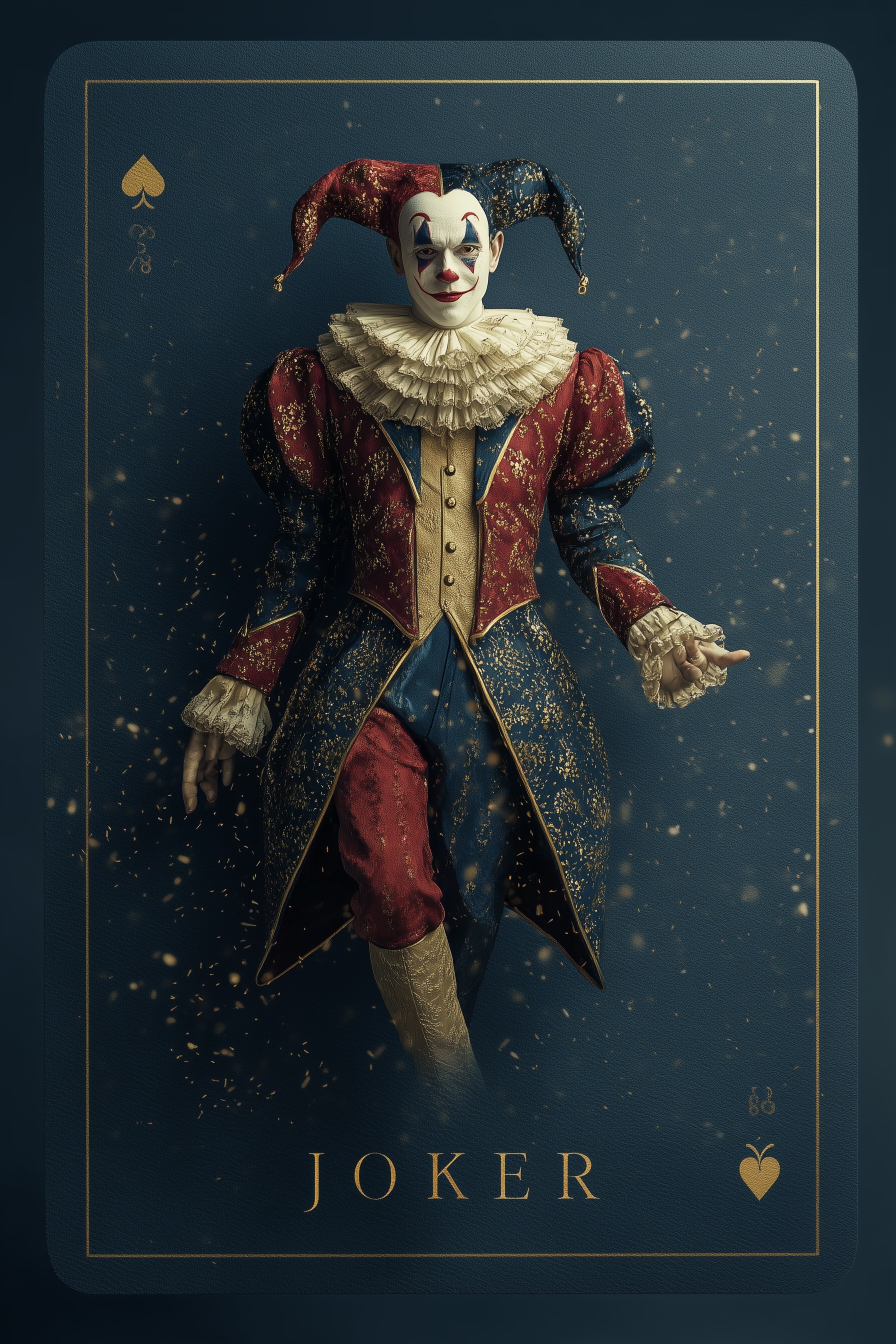
Full-body regal jester standing on a midnight navy playing card surface, aristocratic costume with precise vertical split — crimson velvet left half, deep royal blue brocade right half, heavy gold filigree embroidery catching a sharp rim light from camera-left. Ivory ruffled collar with starched structure, porcelain face paint with cobalt diamond eye patterns and crimson lip detail. Twin-peaked jester hat mirroring the costume split, gold bells with subtle motion blur. Presenting gesture with gloved hand, relaxed contrapposto stance. Fine leather-textured card background with hairline gold border, vintage spade and heart suit symbols in opposing corners, elegant gold "JOKER" lettering integrated at the base with proper kerning. Golden particulate matter in volumetric haze, Rembrandt lighting at a 45-degree key angle, photorealistic digital painting with subsurface scattering on velvet, 8K material detail, cinematic atmosphere, branded asset composition --ar 9:16 --style raw --v 6
The core problem with generating a high-end playing card asset is that abstract quality words like "photorealistic" or "8K material detail" do not instruct the model on how surfaces interact with light. They act as category labels. The renderer satisfies them by applying uniform specular highlights and synthetic-looking textures, which strips the weight out of materials like velvet and brocade. The prompt provided here attempts to solve this by naming physical mechanisms—subsurface scattering, starched structure, sharp rim light—rather than asking for realism as a general aesthetic.
Anchoring the Vertical Split
A costume divided precisely down the center into crimson velvet and royal blue brocade functions as a compositional constraint, not just decoration. It forces the renderer to allocate material properties independently to each side of the frame. However, a prompt that simply says "half red, half blue" usually produces a soft, watercolor-like bleed at the centerline. The supplied prompt anchors the division using the phrase "precise vertical split" and reinforces it by having the twin-peaked hat and ivory ruffled collar mirror the same boundary. Giving the model three aligned structural points increases the chance of a hard edge.
Even with these anchors, expect the centerline to occasionally render as a razor-perfect digital seam rather than a sewn garment edge. If the output looks too mechanical, adding terms like "stitched seam" or "tailored overlap" can introduce the slight asymmetry needed to sell the fabric as constructed clothing. The contrapposto stance and single-gloved presenting gesture are doing necessary work here; they break the bilateral symmetry so the character reads as a figure rather than a flat diagram.
Lighting and Material Separation
The prompt specifies Rembrandt lighting at a 45-degree key angle from camera-left alongside a sharp rim light hitting the gold filigree. This combination demands that the renderer separate two distinct optical behaviors in the same frame. Velvet absorbs light and scatters it within the fibers, producing soft gradients and near-black shadows in the folds. Metallic thread reflects light directionally, creating small, hot specular highlights.
Naming "subsurface scattering on velvet" is an attempt to force the first behavior. Whether the model actually computes subsurface scattering or simply approximates the visual signature depends entirely on the platform and its training data. The exact model version and settings used for the source image are unknown, though the --style raw and --v 6 flags indicate Midjourney. These flags are not universal instructions for other generators.
If the resulting image shows identical brightness on both halves of the split costume, the directional lighting instruction was overridden by a default flat fill. In that case, increasing the contrast between the "midnight navy" background and the rim light, or explicitly describing the shadow side as falling into darkness, may help re-establish the 45-degree angle.
Card Framing and Typography Limits
The playing card environment—fine leather texture, hairline gold border, opposing spade and heart symbols—is designed to function as a reusable brand template. Specifying "opposing corners" for the suit symbols forces the vertical offset seen on standard decks, which signals authenticity faster than centered placement.
Typography remains the weakest point of this approach. The prompt asks for "elegant gold 'JOKER' lettering integrated at the base with proper kerning." Image generation models do not possess typographic engines. They approximate letterforms based on visual patterns in their training sets. The result frequently includes doubled strokes, inconsistent serifs, or broken spacing that falls apart when enlarged beyond thumbnail scale. Plan to use the generated text purely as a layout placeholder. Positioning the word over the plain navy field at the base, as described, ensures a low-detail area where manual typographic overlay is straightforward during post-production.
Resolution and Scope Trade-offs
The --ar 9:16 flag produces a vertical composition suited for mobile screens or printed card proportions. But requesting "8K material detail" alongside complex volumetric haze, golden particulate matter, and dual-material rendering pushes against the limits of what a single pass can resolve cleanly. This is a simulation, not a physical photograph, and the detail will soften if the generation budget is spread too thin.
If the gold filigree dissolves into a uniform smear or the velvet flattens out, the prompt has exceeded the renderer's capacity for simultaneous material fidelity. Adding intensifiers like "hyper-detailed" typically worsens this by introducing sharpening artifacts. The practical fix is subtraction. Drop the volumetric haze or simplify the background texture to free up processing focus for the costume materials. An asset that renders two fabrics convincingly is more useful for game branding than one that gestures at six but resolves none of them.
Comments
Post a Comment