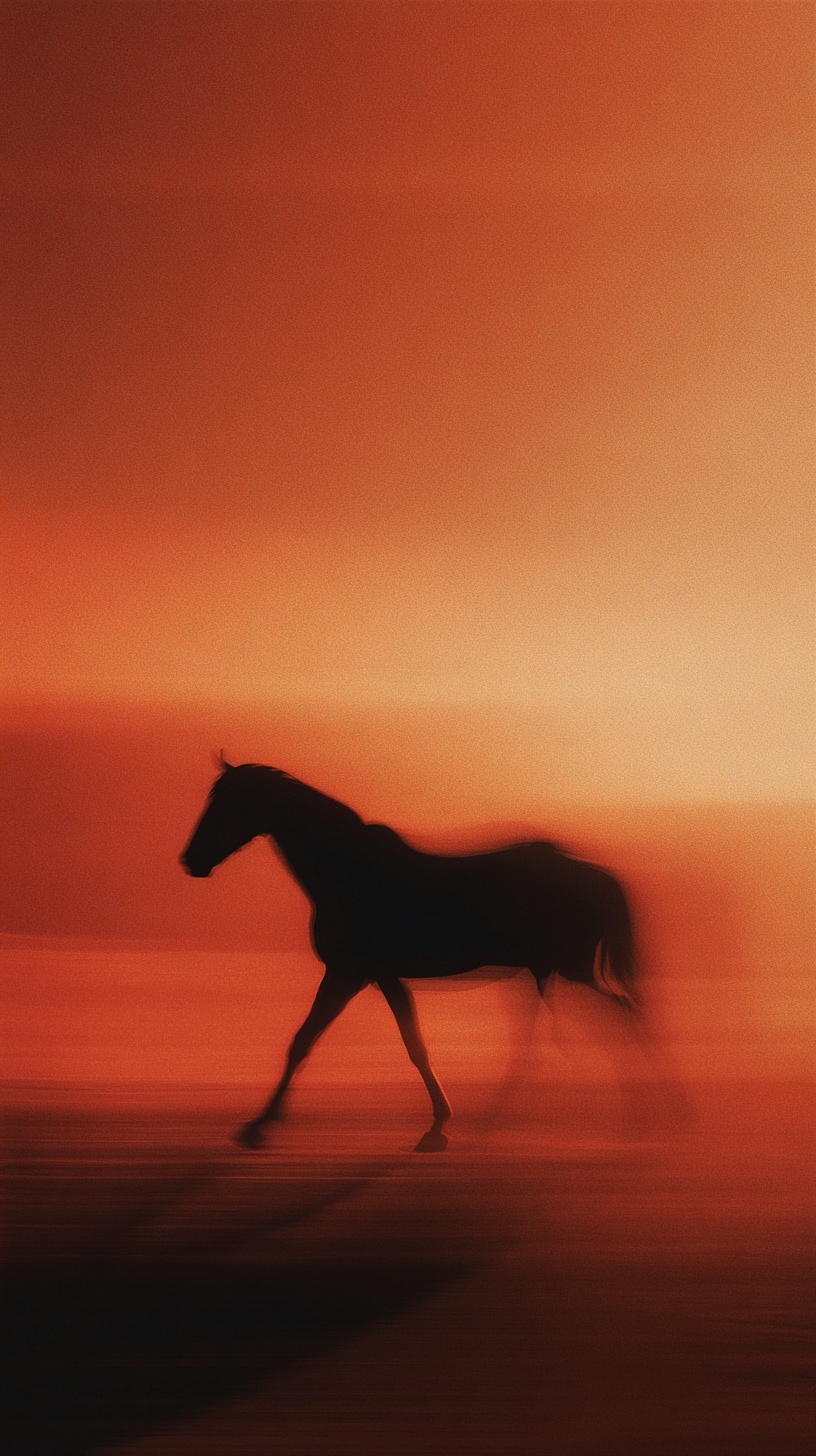
A powerful black horse in full gallop, rendered as a dense silhouette against a gradient sunset sky shifting from nuclear amber through smoldering crimson to deep burnt umber at zenith. Motion blur applied with surgical precision: horizontal velocity streaks through the lower legs and hooves where they meet the dusty ground, while the mane and tail dissolve into vertical liquid trails of movement suggesting wind resistance. The torso and head remain relatively sharp as the motion anchor. Backlit by atmospheric haze that scatters light into volumetric god-rays. Heavy film grain texture, 35mm Kodachrome color science with crushed blacks preserving silhouette density, subtle highlight compression at the horizon line preventing blowout. Shot from a low three-quarter angle, horse positioned left of center following rule of thirds. Cinematic long exposure photography, intentional analog imperfections, raw kinetic energy made visible through controlled temporal distortion. --ar 9:16 --style raw --s 750
Quick Tip: Click the prompt box above to select it, then press Ctrl+C (Cmd+C on Mac) to copy. Paste directly into Midjourney, DALL-E, or Stable Diffusion and customize to make it your own!
The failure mode is specific and recognizable. Ask a model for "a galloping horse with motion blur" and what returns is usually a horse smeared uniformly across every pixel. The silhouette loses its legibility, the head dissolves into the same smear as the tail, and the animal reads as a wet paint streak rather than a moving body. The image has motion, but it has no subject. That is the core bug: the model treats "motion blur" as a global stylization layer, not as a spatial property of individual parts.
The cause is how diffusion models parse the phrase. "Motion blur" is a texture token before it is a physics token. Without an anatomical anchor, the model distributes the effect across the entire latentspace, weighting it by local edge density. High-contrast edges blur first, which means the sharpest features - the head, the defined torso - degrade before the softer background does. The result inverts the intended hierarchy: the subject blurs, the sky stays crisp. Diagnosis before prescription matters here, because the fix is not "less blur," it is directional blur with a protected anchor.
The Silhouette Mass as the Anchor
The torso and head must be explicitly carved out of the blur instruction. In this prompt, the phrase "the torso and head remain relatively sharp as the motion anchor" is doing the heavy lifting. It gives the model a region that is excluded from the temporal distortion, which stabilizes the entire composition. Without a sharp mass, the eye has nowhere to land and the image reads as an error rather than a technique. Silhouette density compounds this: against a bright sky, a crushed black mass creates an absolute value boundary that the model cannot smear without violating its own edge logic.
This is the same principle behind impasto night scene prompts, where texture is deliberately localized to specific surfaces rather than applied to the whole frame. Isolating the effect creates contrast between treated and untreated regions. Global application flattens it.
Horizontal Velocity Only at Ground Contact
The hooves and lower legs receive the horizontal streaks because that is where the body meets the terrain. Assigning "horizontal velocity streaks through the lower legs and hooves where they meet the dusty ground" ties the blur to a physical event rather than a stylistic tag. The model maps the direction to the contact plane, producing streaks that align with the implied ground line. Blur any higher on the leg and the anatomy distorts into a smear that no longer reads as a stride.
Directionality is the parameter that most prompts omit. When blur direction is unspecified, the model defaults to a radial or isotropic spread because it has no vector to organize around. Naming the axis - horizontal at the feet, vertical at the hair - forces the latent space to commit to a coherent motion vector. That single word, "horizontal," changes the output more than any strength value.
Vertical Drag on Mane and Tail
The mane and tail dissolve into vertical liquid trails because they are not striking the ground; they are resisting air. This is a different physical regime, and the prompt separates it with the phrase "vertical liquid trails of movement suggesting wind resistance." The contrast between horizontal at the feet and vertical at the hair is what makes the motion read as three-dimensional. If both regions blurred in the same direction, the horse would look like it is sliding sideways on a conveyor belt.
A related isolation problem appears in feathered portrait prompts, where feather texture must stay distinct from skin and background treatment. Mixed media collapse when a single effect is allowed to bleed across material boundaries. The same boundary discipline applies to hair versus hoof.
The Sunset Gradient as Contrast Engine
The sky is not decoration; it is the contrast engine. "Nuclear amber through smoldering crimson to deep burnt umber at zenith" describes a three-stop gradient that guarantees the black silhouette always has a bright field behind it. Without that gradient, a dark horse on a dark ground disappears. The vertical color shift also gives the model a stable luminance ramp to sample from, which prevents the crushed blacks from clipping into pure #000000 and losing internal definition.
Highlight compression at the horizon line is the second half of this mechanism. Without it, the brightest band of the gradient blows to white, the god-rays vanish into a flat plane, and the silhouette edge loses its halo. Asking for "subtle highlight compression" preserves the atmospheric falloff that makes the backlight legible. The gradient is doing contrast work, not just mood work.
Film Grain and Kodachrome Color Science
"35mm Kodachrome color science with crushed blacks" is a compound parameter that governs both palette and noise. Kodachrome biases reds and yellows toward saturation while holding blues back, which is why the amber-to-crimson range survives without turning orange-muddy. The grain instruction adds analog texture that masks minor AI artifacts in the blurred regions, where smooth gradients tend to band. Grain is not nostalgia here; it is a banding suppressor.
For comparison, Adobe Firefly and Midjourney handle "film grain" differently - Firefly tends to apply it as a uniform overlay, while Midjourney weights it toward shadow regions. The prompt should specify where grain lives if the default distribution is not wanted.
Angle, Placement, and Aspect Ratio
"Low three-quarter angle" and "horse positioned left of center following rule of thirds" are compositional parameters that determine where the motion vector can be read. A low angle compresses the ground plane, which makes the horizontal hoof streaks more prominent. Left-of-center placement gives the horse visual room to move into, so the blur implies direction rather than stasis. In a 9:16 frame, this vertical space is the only way to keep the full body readable.
The controlling principle behind all of the above is allocation, not intensity. Motion blur works when each region receives a direction and a duration appropriate to its physical role, and one mass is exempted entirely to serve as the anchor. Blur is a spatial decision before it is a stylistic one.
Label: Cinematic
Key Principle: Never apply motion blur globally. Assign a direction to each body part: horizontal at ground contact, vertical on loose hair, and keep one mass perfectly sharp as the visual anchor.
Comments
Post a Comment