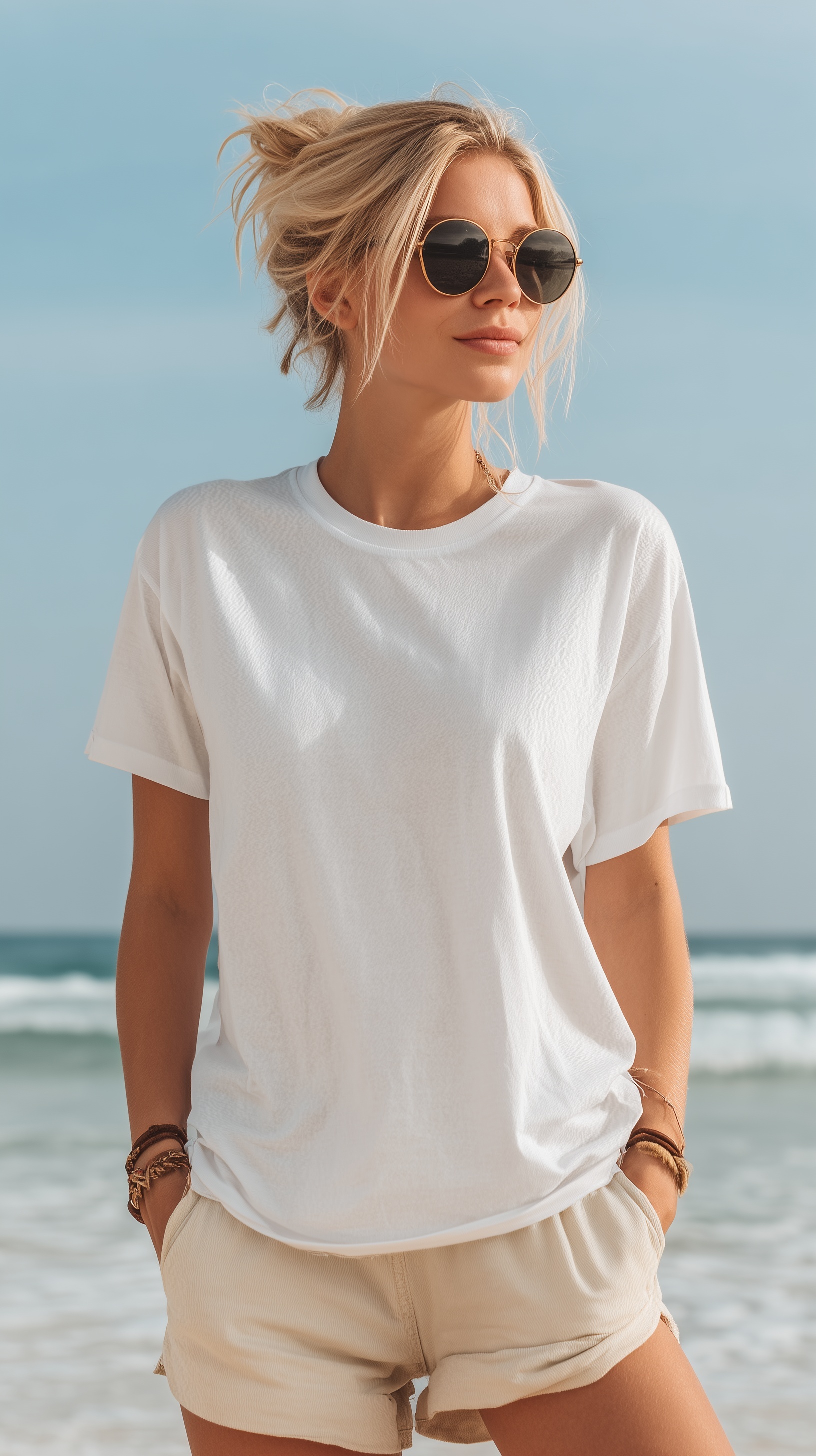
Young blonde woman with windswept messy bun, vintage round gold-rimmed sunglasses with dark lenses, oversized boxy white cotton t-shirt with visible ribbed collar texture and natural drape creases, high-waisted beige linen shorts with front pleats and relaxed fit. Hands tucked casually into shorts pockets, slight forward shoulder roll. Multiple thin gold chain necklaces layered at varying lengths, stack of woven leather and cord bracelets on both wrists. Slight sun-kissed glow on skin with visible pore texture on cheeks, natural makeup with tinted lips and faint freckles across nose. Looking 15 degrees off-camera toward ocean horizon, relaxed confident expression with soft closed-mouth smile, subtle jaw tension. Standing on pale sandy beach with gentle turquoise waves and clear cerulean sky behind, soft atmospheric haze on horizon line. Bright diffused midday sunlight from 45-degree angle camera left, minimal shadows, airy coastal atmosphere, slight rim light on hair. Color palette: crisp white, warm sand beige, ocean teal, sky blue, gold metallics, sun-warmed skin tones. Medium shot from mid-thigh up, portrait orientation 9:16, subject positioned right of center following rule of thirds, negative space above for text overlay. Shot on 85mm equivalent lens, f/2.8 aperture, shallow depth of field with creamy bokeh on background water, tack sharp focus on fabric weave details and facial features. Professional fashion photography, editorial quality, 8K resolution, high dynamic range, subtle 35mm film grain, color graded for warm summer aesthetic with lifted shadows --ar 9:16 --style raw --v 6
Quick Tip: Click the prompt box above to select it, then press Ctrl+C (Cmd+C on Mac) to copy. Paste directly into Midjourney, DALL-E, or Stable Diffusion and customize to make it your own!
The generation process begins with token weighting, not with the subject description. When the model parses the first token group of a prompt, it assigns disproportionate attention to the opening noun phrase. In this prompt, "Young blonde woman" establishes the primary subject cluster before the model processes any styling or environmental data. If the opening tokens describe a generic subject, the model defaults to a composite average face and body type that resists subsequent refinement. The mechanism is straightforward: early tokens anchor the latent space trajectory, and later tokens can only modulate within the variance the initial anchor allows.
This is why the specific ordering of "windswept messy bun" before "vintage round gold-rimmed sunglasses" matters. Hair description precedes accessory description because hair defines the silhouette contour, while glasses define the facial focal point. Reversing the order tends to produce a face-first composition where the hairstyle becomes an afterthought. The model allocates spatial resolution according to token sequence, and the first three to five tokens receive the highest attention weight in the cross-attention layers. For apparel mockups, the subject descriptor must be precise enough to prevent the model from substituting its default commercial model archetype.
Fabric Texture Parameters and Garment Fidelity
The phrase "oversized boxy white cotton t-shirt with visible ribbed collar texture and natural drape creases" does more work than any lighting descriptor in the prompt. "Oversized boxy" controls the silhouette geometry, preventing the model from rendering a fitted garment. "Visible ribbed collar texture" forces the model to allocate pixel-level detail to the neckline, which is the primary failure point in apparel mockups. Without this specification, the collar renders as a smooth painted band with no material identity. "Natural drape creases" instructs the model to simulate gravity and fabric weight, producing the folds that signal real cotton rather than digital mesh.
The same principle applies to "high-waisted beige linen shorts with front pleats and relaxed fit." Linen has a distinctive surface quality, slightly irregular, with a matte finish that differs from cotton. Specifying the fiber type changes the render because the model associates "linen" with specific texture patterns in its training data. Front pleats create structural shadows that reveal garment construction, while "relaxed fit" prevents the model from tightening the waistband against the body. For a deeper look at how garment prompts interact with subject posing, the street portrait breakdown covers similar parameter interactions in a different lighting context.
Skin Realism and the Pore Texture Problem
"Slight sun-kissed glow on skin with visible pore texture on cheeks" is the parameter that separates editorial photography from plastic renders. The model interprets "visible pore texture" as a demand for micro-detail in the skin shader, which prevents the default smoothing that makes AI portraits look synthetic. The phrase "faint freckles across nose" adds a secondary detail layer that the model treats as a surface map rather than a color overlay. Without these two specifications, the skin renders with uniform albedo and no subsurface scattering variation, producing the waxy appearance common in unrefined portrait prompts.
Natural makeup receives similar treatment. "Tinted lips" specifies a color shift without defining the exact shade, allowing the model to derive a tone consistent with the warm color palette. If the prompt specified "red lipstick," the model would render a saturated, opaque lip that breaks the naturalism. The mechanism is about constraint specificity: broad categories like "natural makeup" give the model freedom to choose a coherent palette, while narrow descriptors like "red lipstick" override the palette logic and produce a discordant result.
Lighting Direction and Atmospheric Depth
"Bright diffused midday sunlight from 45-degree angle camera left" is a compound parameter that controls shadow softness, direction, and color temperature simultaneously. Diffused light at midday eliminates harsh shadow edges, which keeps the garment readable without sacrificing depth. The 45-degree angle from camera left creates a subtle modeling effect on the face and shirt folds, revealing form without dramatic contrast. "Minimal shadows" reinforces the diffusion, preventing the model from defaulting to high-contrast studio lighting that would contradict the beach setting.
"Soft atmospheric haze on horizon line" is the depth cue that separates foreground from background. Without it, the ocean and sky render as flat color fields with a hard horizon edge. Haze introduces aerial perspective, which the model interprets as distance and produces a gradient of decreasing contrast toward the background. "Slight rim light on hair" adds a directional highlight that separates the subject from the sky, a technique borrowed from portrait photography that prevents the head from merging into the background. For prompts where atmospheric separation is the primary challenge, the organic product workflow demonstrates comparable haze and depth layering.
Lens Simulation and Depth of Field Control
"Shot on 85mm equivalent lens, f/2.8 aperture" tells the model to simulate a specific optical compression and depth falloff. The 85mm focal length produces a flattering facial perspective with minimal distortion, while f/2.8 creates a shallow depth of field that blurs the background water into creamy bokeh. The phrase "tack sharp focus on fabric weave details and facial features" overrides the natural tendency of the model to apply uniform sharpness. Without it, the model may render the entire image with equal detail, destroying the separation between subject and environment.
"Subtle 35mm film grain" and "color graded for warm summer aesthetic with lifted shadows" are post-processing directives that the model applies during generation. Film grain adds micro-texture that breaks up digital smoothness, while lifted shadows prevent the dark areas from clipping to pure black. The combination produces the low-contrast, airy look associated with editorial beach photography. "8K resolution, high dynamic range" are quality boosters that increase the model's internal render resolution and tonal range, though their effect diminishes if the core parameters are inconsistent.
Verification Checklist Before Accepting the Render
Check the collar first. If the ribbed texture is missing or the neckline is a smooth band, the fabric descriptor failed to propagate and the prompt needs reweighting. Second, inspect the hands. "Hands tucked casually into shorts pockets" is a high-risk pose because models frequently merge fingers or produce anatomical errors in occluded areas. If the hands are malformed, consider removing the pose specification and letting the model choose a neutral arm position.
Third, verify skin texture at 100 percent zoom. Pores and freckles should be visible without being exaggerated. If the skin appears plastic, add "subsurface scattering" or increase the weight of the pore texture phrase. Fourth, confirm the horizon line has haze gradient rather than a hard edge. Fifth, check that the negative space above the subject is clean and usable for text overlay. Sixth, verify that the gold accessories render with metallic specularity rather than flat yellow color. Any failure in these six checks indicates a specific parameter that needs adjustment before the image is suitable for mockup use.
Label: Fashion
Key Principle: Prioritize specific fabric descriptors like "ribbed collar texture" and "natural drape creases" over generic terms like "white shirt" to force the model to render tangible garment details.
Comments
Post a Comment